
How to Become a Truck Driver in California (2026): From Class C to CDL
Is your Class C license limiting your income? Discover the reality of becoming a truck driver in CA, including real costs, the ELDT training mandate, and the "Manual vs Automatic" trap.
"I have a driver's license, I know how to drive." This is the first lie every aspiring trucker tells themselves before they realize that a semi-truck has more in common with a ship than a sedan.
Most Californians are stuck in a cycle of delivery gigs or service jobs, relying on a standard Class C license to survive the rising cost of living in 2026. But the gap between "driving for a living" and "being a professional driver" has widened into a massive financial canyon. While a delivery van driver in Los Angeles might struggle to clear $50,000 a year, a first-year Class A driver is often looking at $75,000 or more with full benefits. To make that jump in the Golden State, you have to be ready to shift your mindset as much as your gears.
This isn't your typical DMV checklist. It's a deep dive into the psychological and technical pivot the job demands. We're going to talk about the things schools don't mention: the manual transmission trap, the medical gates you must pass, and exactly how long CDL school really takes once you factor in the current California DMV backlog. Whether you're driving on a regular license today or starting from scratch, this is your roadmap to a six-figure career.
The Class C Baseline: What You Can Drive Now
To understand the leap you're about to take, you first need to understand the limits of your current license. In California, the Class C is your standard car license, designed for personal mobility and most of the everyday vehicles you see on the road.
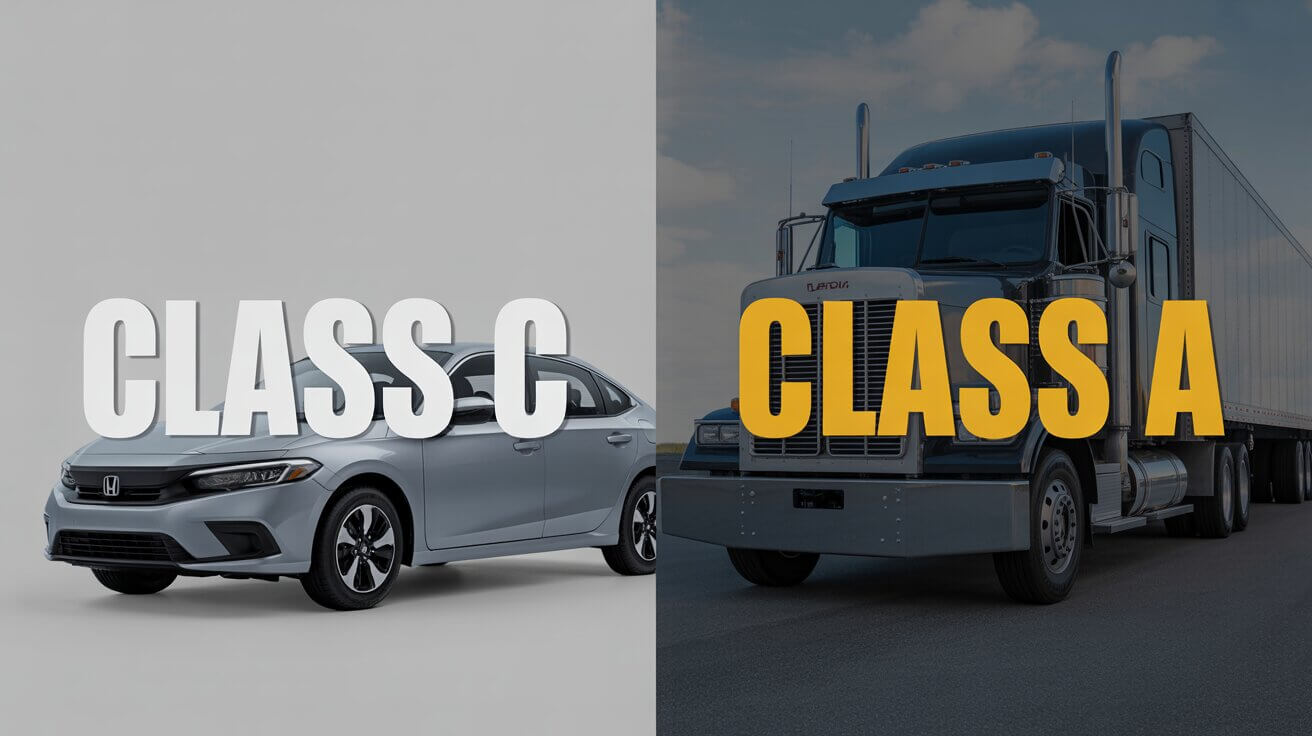
With a Class C, you can legally drive any 2-axle vehicle with a Gross Vehicle Weight Rating (GVWR) of 26,000 lbs or less. That covers your personal vehicles—cars, small SUVs, and even many of the U-Haul towing setups you might use for moving house. You can even drive a 3-axle vehicle weighing less than 6,000 lbs. But these vehicles are limited by nature. A standard license does not authorize you to handle the kinetic energy of a commercial vehicle equipped with air brakes or the complexity of a 53-foot trailer.
Many drivers think they can "hack" the system by driving large box trucks or step-vans. While some of these fall under the 26,000 lbs limit, the moment you're paid to transport goods for a carrier, you enter a different legal realm. Relying on a regular license for work usually leaves you in the "gig economy" tier—Amazon DSP, DoorDash, or local couriers. To reach industrial-grade wages, you have to move beyond these baseline privileges and into the specialized world of the CDL.
How Long is CDL School in California?
The most common question we get is simple: how long is CDL school? For someone working a regular driving job today, taking time off to train is a major financial risk. You need a timeline you can plan your life around.
Why a Quality Program Runs About 160 Hours
Since the federal ELDT mandate took effect (you can confirm any school on the official FMCSA Training Provider Registry), you can no longer "shortcut" your way to a license. ELDT itself doesn't set a fixed number of training hours, but a reputable California school in hubs like Fontana, Fresno, or Sacramento typically runs around 160 hours over 4 to 5 weeks of full-time attendance.
The Breakdown: Classroom, Range, and Road
Your time in school splits into distinct phases, and the balance between them is critical for passing the state exam:
- The Classroom (Phase 1): This is the theoretical foundation. You spend 40 to 50 hours studying the California CDL Handbook, hours-of-service (HOS) logs, and defensive driving theory. You are essentially studying to pass the DMV's written permit tests.
- The Range (Phase 2): This is where the four-wheeler ego goes to die. You spend 60+ hours in a lot learning "Backing." You'll practice the Straight Line Back, the Offset Back, and the dreaded Alley Dock. You will realize that steering a trailer is the exact opposite of steering a car.
- The Road (Phase 3): The final 50+ hours are spent on public California roads. You'll practice upshifting and downshifting, managing your "off-tracking" on tight right turns, and maintaining lane control while 40 tons of weight pushes you forward.
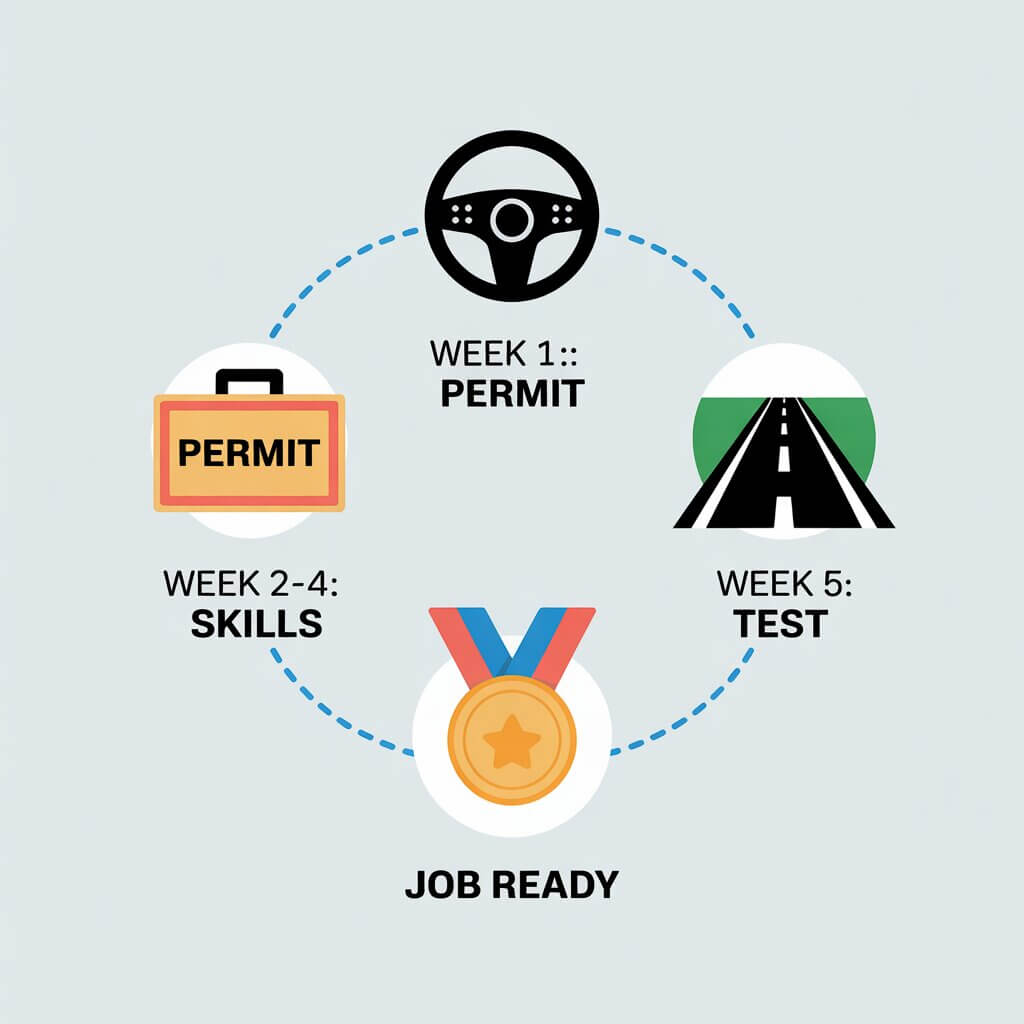
So how long is CDL school in total? Add the roughly 3-week wait for a California DMV test appointment, and most students go from license holder to professional trucker in about 90 days. If you're starting from zero, our Complete Guide to Class A in CA has a week-by-week breakdown.
Choosing Between a Class A and Class B License in CA
Before you enroll, you have to decide between a Class A and a Class B license. This isn't just about the size of the truck; it's about the life you want to lead, and it's a common point of confusion for people coming from a regular driving background.
The Local Champion: Class B
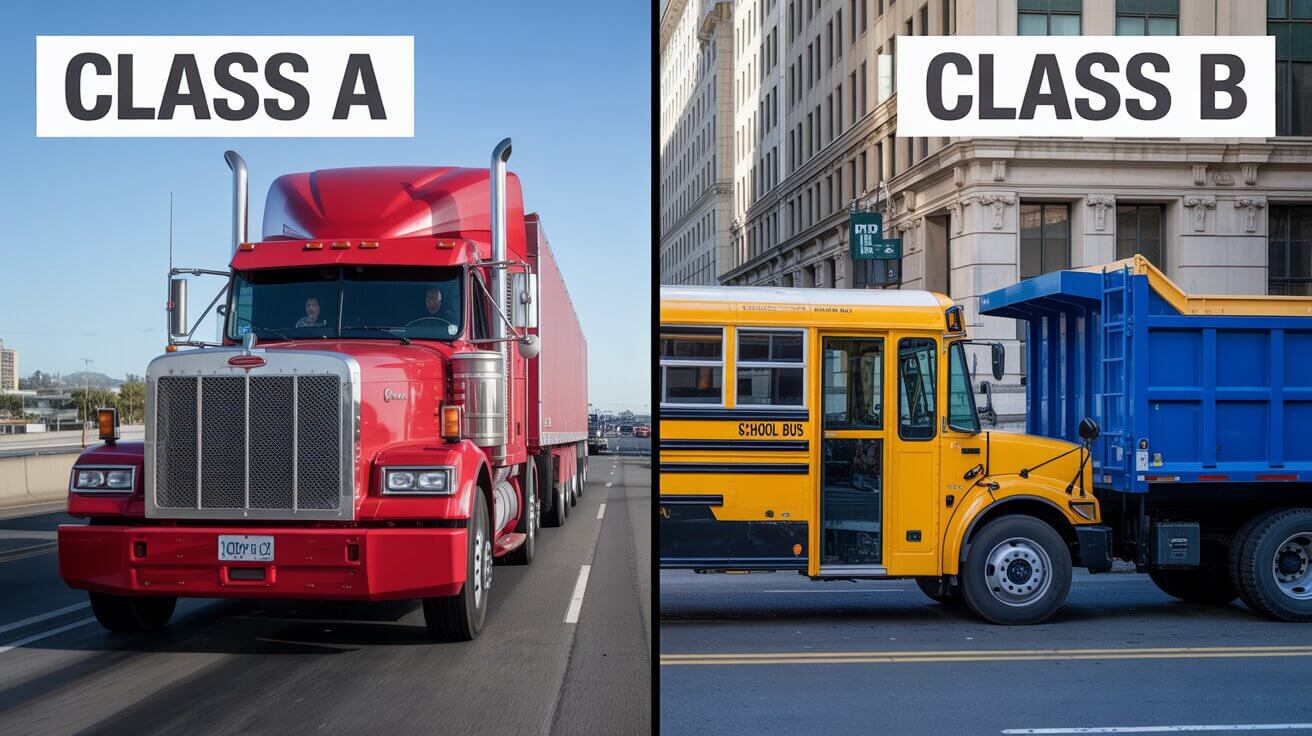
A Class B license lets you drive "straight trucks," where the engine and the cargo area sit on the same frame—think dump trucks, cement mixers, and garbage trucks. It also covers passenger vehicles like city transit and school buses. The big advantage is that most Class B jobs are "home daily." If you want commercial pay but still want to sleep in your own bed every night, Class B is your target. Our Class B California Career Guide covers it in depth.
The High-Earner: Class A
Class A is for the big rigs—tractor-trailers. This is where the "local vs. OTR" (Over-the-Road) debate lives. As a Class A driver, you can pull loads over 10,000 lbs, which opens the door to regional and national freight. It takes more skill, but the pay scale is significantly higher. The catch is the complexity of "Combination Vehicles," something a regular license never taught you.
For a detailed salary and lifestyle comparison, see our Class A vs Class B Deep Dive.
From Class C to Class A: The 5-Step Transition
If you're serious about the goal, you need to follow a federal roadmap. This five-step process is the only way to legally upgrade to a professional license in 2026.
Step 1: The DOT Medical Exam
Unlike a regular license, a CDL requires a DOT medical exam every two years. A certified DOT doctor will check your blood pressure, vision, and hearing. If you have a history of heart issues, seizures, or a high BMI that indicates sleep apnea, this is the first gate that could stop your career before it starts. We detailed these health barriers in our CDL Disqualifications Guide.
Step 2: The Permit Test (CLP)
You can't touch a truck until you hold a learner's permit. That means three written exams at the DMV: General Knowledge, Air Brakes, and Combination Vehicles. Most car drivers fail the Air Brakes section on their first try because it involves memorizing specific PSI numbers, so studying with a California practice test is non-negotiable. See our Permit Test Study Guide for the exact strategy.
For complete test preparation strategy, check our California Practice Test Guide.
Step 3: Mastering the Pre-Trip Inspection
This is the "secret" part of the test. You must walk around the truck and identify over 100 components, from the Pitman Arm to the Air Compressor. You must prove they are 'Securely mounted, not cracked, bent, or broken' and that there are no leaks. This is the hardest part for drivers who have never looked under a hood. Your road-test prep starts here. Master it with our Pre-Trip Inspection Script.
Step 4: The Backing Maneuvers
On the range, you learn that a semi-truck doesn't turn like a car; you have to "swing wide" to avoid clipping curbs—a habit that's hard to break after years of driving four-wheelers. You'll master the "Alley Dock" and "Offset" maneuvers.
Step 5: The State Road Exam
A DMV examiner will evaluate your skills on public roads. Clip a curb or miss a gear (if you're testing in a manual) and you fail immediately. Pass, and you officially move from everyday driver to professional CDL holder.
The Salary Jump: Class C vs CDL Professionals
Why go through all this? Because a commercial driver's salary in 2026 is one of the most stable paths to the middle class in California. Put a delivery driver next to a trucker and the income gap is staggering.
In 2026, entry-level pay for a Class A driver in California averages around $34.00 per hour. Compare that to a standard delivery job at roughly $22.00 per hour.
| Career Path | License Required | Avg. California Salary |
|---|---|---|
| Courier / Van Delivery | Class C | $44,000 - $49,000 |
| Waste Management / Dump Truck | Class B CDL | $62,000 - $78,000 |
| LTL Freight / Fuel Hauling | Class A CDL | $85,000 - $125,000+ |
That kind of income can put a home in the Inland Empire or the Central Valley within reach—a pipe dream on most delivery wages. Even after you factor in the cost of school, the return on investment usually lands within the first six months of employment. If cost is the barrier, look into WIOA grants in California, which can cover 100% of your tuition through an America's Job Center (AJCC).
The Verdict: Is 2026 Your Year to Upgrade?
A Class C license is a tool for mobility; a CDL is a tool for prosperity. Weigh the few weeks of school against the lifetime return on investment and the choice is clear. If you're tired of the "delivery gig" grind and want a recession-resistant career, the path to a professional license in California is wide open.
Your Next Step: Go to the DMV, get the handbook, and start studying. Your future is waiting just one gear shift away.
Ready to Find CDL Schools?
Search for CDL training programs in your area. Start your journey to becoming a professional truck driver today.
Find CDL Schools Near YouRelated Articles

Texas CDL School Cost (2026): A Complete Guide to Tuition, Fees & Free Training
Planning to get your CDL in Texas? Discover the real cost of CDL training in Dallas, Houston, and San Antonio. Learn about TWC grants, WIOA funding, and hidden fees.
How to Become a Truck Driver in Texas (2026): The Ultimate Class C to CDL Roadmap
Tired of your Class C income? Learn how to become a truck driver in Texas. From DPS requirements to Dallas salaries and Houston port jobs, discover why TX is the #1 state for truckers.

Mastering the Texas State Practice CDL Test (2026): Your Ultimate DPS Prep Guide
Prepare for your Texas DPS exam with our comprehensive guide to the Texas state practice CDL test. Master General Knowledge, Air Brakes, and the 2026 skip strategy.