
California Class B License Guide (2026): The "Local" CDL for Buses & Dump Trucks
Want a commercial career without the OTR lifestyle? The definitive guide to the California Class B CDL, covering the CHP School Bus Certificate, the "House Car" rule for RVs, and the unionized transit jobs in LA and SF.
In the world of commercial driving, the "Class A" gets all the glory. But in California, the smart money is increasingly moving toward the Class B CDL.
Why? Because the Class B license offers something that long-haul trucking cannot: Stability.
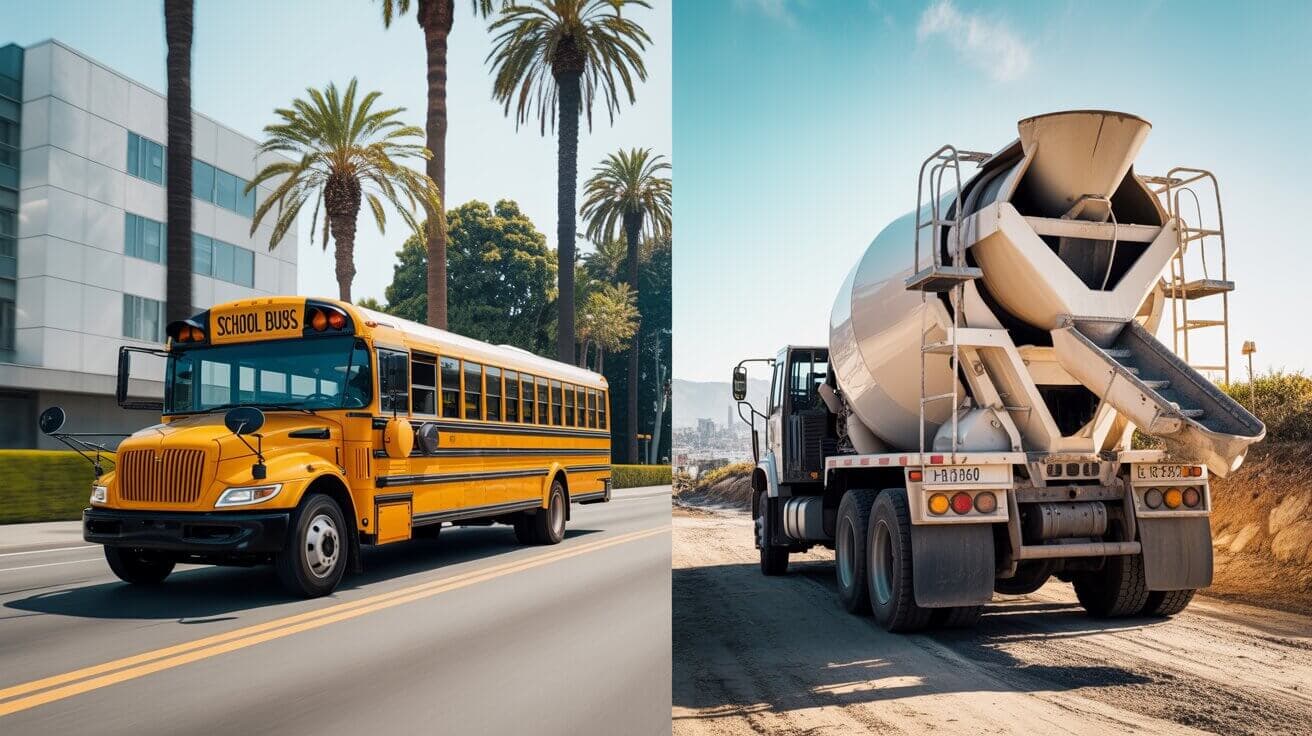
Class B drivers operate the machinery that keeps California's cities running: the transit buses of Los Angeles, the concrete mixers building San Francisco's skyline, and the school buses in every suburb. These jobs are almost exclusively local, often unionized, and allow you to sleep in your own bed every single night.
However, obtaining a Class B license in the Golden State is not as simple as "driving a smaller truck." It involves a complex web of certificates—specifically the Passenger (P) endorsement and the dreaded CHP School Bus Certificate. This guide is not just a checklist; it is a career roadmap to navigating the bureaucracy of the DMV and the California Highway Patrol to secure a high-paying local career.
1. The Great Divide: "People" vs. "Property"
Unlike a Class A license, where the job is almost always "hauling freight," a Class B license splits your career path into two very different directions immediately. You need to choose your "Tribe" before you even apply for a permit.
Path A: The "Passenger" Career (The Blue Collar Professional)
This path is about precision, customer service, and safety. You are transporting the most valuable cargo on earth: humans.
The Vehicles: City Transit Buses (LA Metro, Muni), Tour Coaches (Vegas runs), Shuttles (Google/Apple employee buses), and School Buses.
The Vibe: You wear a uniform. You deal with the public. Safety regulations are extreme.
The Pay: often $30-$45/hour with strong Union benefits (Teamsters or ATU).
Path B: The "Construction" Career (The Heavy Operator)
This path is about grit, horsepower, and skill.
The Vehicles: Dump Trucks (Super 10s), Concrete Mixers, Refuse (Garbage) Trucks, and Utility Trucks.
The Vibe: You wear boots and a vest. You work on active construction sites. It is dusty, loud, and physically demanding.
The Pay: often "Prevailing Wage" on government contracts, which can exceed $50/hour.

2. The "School Bus" Gauntlet: Surviving the CHP
This is the most critical section of this guide. If you plan to drive a School Bus in California, a CDL is NOT enough.
California has the strictest school bus laws in the nation. You must obtain the California Special Driver Certificate (Form DL 45). This process is handled not just by the DMV, but by the California Highway Patrol (CHP).
The 4-Step CHP Certification Process
- The Background Check (Live Scan): This is deeper than a standard check. Any history of violence, drug use, or "Moral Turpitude" (crimes involving dishonesty, fraud, theft, or sex offenses) will disqualify you instantly.
- The Medical (DL 51): You need a DOT physical, but the CHP reviews it personally. Issues like sleep apnea or diabetes are scrutinized heavily.
- The First Aid Test: You must pass a CHP-administered First Aid exam or hold a valid Red Cross First Aid card.
- The "T-01" Card: Before you can even test, you need to complete 20 hours of classroom time and 20 hours of behind-the-wheel training. This is mandated by the CHP School Pupil Transportation Safety Program. No T-01, No Test.
Pro Tip: Most School Districts offer "Paid Training." They will hire you as a trainee, pay for your background check, and provide the certified instructor for the T-01 card. Do not pay a private school for this unless you have to.
Map: The CHP Commercial Vehicle Section HQ in Sacramento. Most testing, however, is done at your local CHP Division office.
3. The "Non-Commercial" Class B: The RV Loophole
We receive hundreds of emails asking: "I bought a 45-foot Diesel Pusher RV. Do I need a CDL?"
The Answer: You do NOT need a commercial license (CDL), but you DO need a "Non-Commercial Class B" license.
The "House Car" Rule (VC 12804.10): If your RV is over 40 feet long, or if you are towing a heavy trailer that puts you over 26,000 lbs GCWR (Gross Combined Weight Rating) but it is for personal use, you must upgrade your Class C license.
How to get it:
- Application: Fill out the DL 44 form at the DMV.
- Written Test: Take the "Recreational Vehicle" law test (Class B Non-Commercial).
- Health Questionnaire: Fill out the Health Questionnaire (Form DL 546). A full DOT physical is usually not required for personal use, but you must self-certify your health using this PDF.
- Skills Test: You must bring your RV to the DMV for a skills test. Yes, you have to parallel park your 45-foot motorhome.
4. Critical Endorsements: The Keys to the Kingdom
A "blank" Class B license is almost useless. To get hired, you need letters on your license. Here is what they mean and why you need them.
The "P" (Passenger) Endorsement
Required for: Any vehicle designed to carry 16 or more passengers (including the driver).
The Test: 20 questions on passenger safety, emergency exits, and managing unruly riders.
Why get it? It opens up the world of shuttles, limos, and tour buses. Full details in our Passenger & School Bus Endorsement Guide.
The "S" (School Bus) Endorsement
Required for: Driving students.
The Test: 25 questions specifically about "Danger Zones," student loading/unloading procedures, and railroad crossings.
Note: You cannot get the 'S' without the 'P'. They go together.
The "Tanker" (N) Endorsement (For Construction)
Required for: Water trucks (dust control on construction sites) or Fuel trucks.
Why get it? On a construction site, the "Water Truck Driver" often has the easiest job (driving in circles spraying water) and gets paid the same union rate as the hard workers. It is the "retirement job" of construction.
5. The "Restriction" Minefield: Don't Limit Your Pay
When you pass your test, the DMV loves to slap "Restrictions" on your license. These are career killers. Here is how to avoid them.
Restriction L: "No Air Brakes"
If you take your test in a rental truck or a small shuttle bus that uses hydraulic brakes (like a car), you get an 'L' restriction.
The Consequence: You cannot drive 95% of commercial vehicles. No dump trucks, no big buses.
The Fix: ALWAYS ensure your training vehicle has Air Brakes. Memorize the Air Brake check. It is non-negotiable.
Restriction E: "No Manual Transmission"
If you take your test in an Automatic, you get an 'E' restriction.
The Consequence: For bus drivers, this is fine (buses are automatic). But for Construction Drivers, this is bad. Many concrete mixers and heavy dump trucks still use 8LL or 10-speed manuals for torque.
The Fix: If you want to work in construction, find a school that trains on manual transmissions.
6. The Pre-Trip Inspection: Bus vs. Truck Differences
The Pre-Trip inspection for Class B varies wildly depending on your vehicle. The California DMV examiners are notoriously strict about the differences.
If you test in a BUS:
- Emergency Exits: You must physically open every emergency window and roof hatch and listen for the alarm buzzer.
- Passenger Entry: You must inspect the step treads, handrails, and the door mechanism.
- Seating: You must check that seat frames are secure to the floor.
If you test in a TRUCK (Dump/Box):
- Coupling System: Even though you are Class B, if your truck has a pintle hook (for towing small trailers), you must inspect it.
- Lift Gate: If equipped, you must demonstrate it works.
- Load Securement: You must explain how you would secure cargo (straps/chains).
Watch: The official California "Transit Style" School Bus Pre-Trip. This covers the strict student safety checks.
7. The "ELDT" Mandate: Shorter and Cheaper?
Since February 2022, the federal ELDT (Entry-Level Driver Training) mandate applies to Class B. You cannot skip school.
However, Class B school is significantly different from Class A:
- Duration: Typically 3 weeks (vs. 5-6 weeks for Class A).
- Hours: Usually 40-80 hours.
- Cost: $2,500 - $3,500.
The "Free" Option (Transit Agencies): Major agencies like LA Metro or AC Transit (Bay Area) run their own internal ELDT programs. They pay you while you train. This is the "Golden Ticket." You apply as a "Bus Operator Trainee," get paid $20+/hour to learn, and graduate with your license and a job.
8. Salary Reality: What Can You Earn?
Let's talk numbers. California is expensive, so does Class B pay enough?
| Sector | Entry Pay (Year 1) | Top Pay (Year 5+) | Pros/Cons |
|---|---|---|---|
| City Transit (Union) | $28 - $32 / hr | $45+ / hr | Pension, split shifts. |
| School Bus | $22 - $28 / hr | $35 / hr | Part-time hours, summers off. |
| Private Coach (Tours) | $25 / hr + Tips | $35 / hr + Tips | Tips can be huge ($100/day). |
| Construction (Dump) | $26 / hr | $40+ / hr | Hard on the body, seasonal. |
Frequently Asked Questions (California Class B)
Can I drive a semi-truck with a Class B license?
No. A Class B CDL only allows you to drive a single vehicle with a GVWR of 26,001 lbs or more. You can tow a trailer, but the trailer MUST be under 10,000 lbs GVWR. If you want to pull a heavy trailer (like a 53-foot dry van), you must upgrade to a Class A.
Is the California Class B test hard?
The driving portion is generally easier than Class A because you do not have to worry about "jackknifing" a trailer while backing up. However, the Pre-Trip Inspection is just as detailed. You must memorize over 100 items on the vehicle.
How much does a Class B license cost in California?
Expect to pay between $2,000 and $3,500 for a private school. However, if you get hired by a School District or Transit Agency (like LA Metro), the training is usually free, and they pay you an hourly wage while you learn.
Do I need a Class B for a massive RV?
If your RV is over 40 feet long, yes, but it is a "Non-Commercial Class B." You do not need a medical card or a logbook, but you do need to pass a written and skills test at the DMV.
The Verdict: Is Class B Right for You?
If you value being home for dinner every night and want a career with strong union protection, the California Class B CDL is the superior choice over Class A.
Your Next Steps:
- Choose your path: Do you want to haul People or Concrete?
- Get the Permit: Study for General Knowledge, Air Brakes, and Passenger endorsements.
- Apply strategically: Look for "Paid Training" jobs at School Districts or Transit Agencies before paying for private school.
- Prepare for the CHP: If driving a bus, keep your record clean and prepare for the rigorous background check.
Ready to start? Check our list of Class B Training Programs near you.
Compare your options: See whether Class A is worth it in our Class A vs Class B comparison, get the full licensing path in the California CDL guide, and check the CDL Disqualifications guide before you apply.
Ready to Find CDL Schools?
Search for CDL training programs in your area. Start your journey to becoming a professional truck driver today.
Find CDL Schools Near YouRelated Articles

Texas CDL School Cost (2026): A Complete Guide to Tuition, Fees & Free Training
Planning to get your CDL in Texas? Discover the real cost of CDL training in Dallas, Houston, and San Antonio. Learn about TWC grants, WIOA funding, and hidden fees.
How to Become a Truck Driver in Texas (2026): The Ultimate Class C to CDL Roadmap
Tired of your Class C income? Learn how to become a truck driver in Texas. From DPS requirements to Dallas salaries and Houston port jobs, discover why TX is the #1 state for truckers.

Mastering the Texas State Practice CDL Test (2026): Your Ultimate DPS Prep Guide
Prepare for your Texas DPS exam with our comprehensive guide to the Texas state practice CDL test. Master General Knowledge, Air Brakes, and the 2026 skip strategy.