
The Ultimate Guide to Passing the CDL Permit Test (CLP) in 2026
Dreading the written exam? Stop reading the 180-page DMV manual. Here is the massive, step-by-step strategy to crush General Knowledge, Air Brakes, and Combination Vehicles on your first try.

So, you want to be a truck driver. You have checked the salary reality, you found a school, and you are ready to roll.
There is just one massive, boring obstacle standing in your way: The Commercial Learner's Permit (CLP) Exam.
You go to the DMV website, download the official CDL Manual, and your heart sinks. It is a 180-page government document written in tiny font, full of technical jargon about "S-Cam Drum Brakes" and "Tie Rods."
Good news: You do NOT need to memorize that whole book. In fact, reading the manual cover-to-cover is the best way to confuse yourself and fail.
I have helped hundreds of students pass this test. The secret isn't being a genius mechanic; it's understanding how the test is built. Here is the "Insider Strategy" to passing the CLP test on your first try, saving you time and DMV re-testing fees.
1. The "Big Three": What You Actually Need to Study
The CDL Manual covers everything from School Buses to Hazardous Materials. But to get your Class A Permit and start driving a semi-truck, you only need to pass three specific sections. If you study "Tankers" or "Doubles" right now, you are wasting valuable brain space.
Focus 100% of your energy on these three:
A. General Knowledge (The Marathon)
This is the longest test. It covers the physics of driving a heavy vehicle.
Questions: 50
Passing Score: 40 correct (80%)
Key Topics: Night driving, winter driving, accident procedures, and cargo safety.
B. Air Brakes (The Technical One)
This is the hardest part for new drivers. You must understand how the air compressor, tanks, and emergency brakes work. If you fail this, you get a "Restriction L" and can't drive semi-trucks (only pickup trucks with trailers).
Questions: 25
Passing Score: 20 correct (80%)
C. Combination Vehicles (The Tractor-Trailer)
This covers the unique challenges of driving an articulated vehicle: coupling, uncoupling, and the "off-tracking" effect.
Questions: 20
Passing Score: 16 correct (80%)
Insider Tip
Do not take the "Endorsements" tests (Hazmat, Tanker, Doubles) yet. Get your core permit first. You can add the fancy stuff later once you are hired (our CDL Endorsements Guide covers which ones pay, and the Hazmat practice test when you're ready). Keep it simple to avoid "Information Overload."
2. The "App Strategy": Throw Away the Manual
The official manual is dry, boring, and often outdated. The questions on the real DMV computer, however, are almost identical to the ones found in free practice apps.
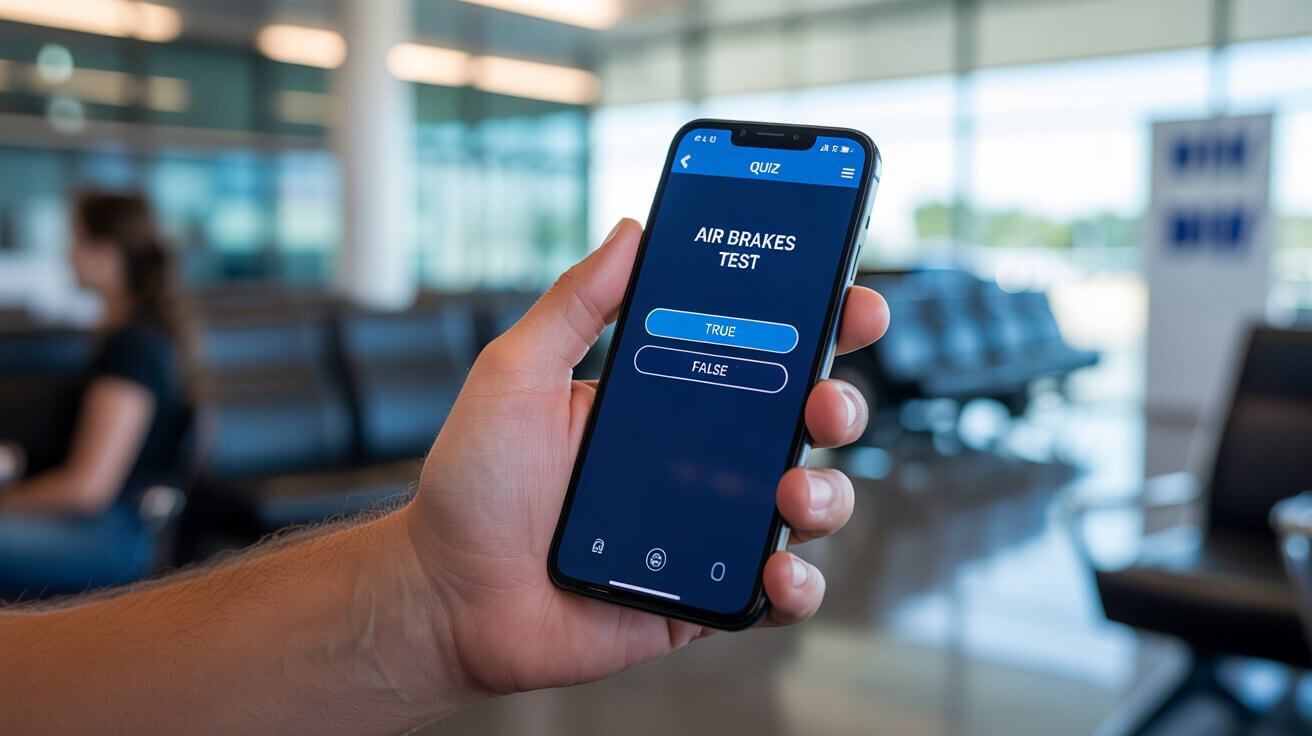
The Tool: Download an app called "CDL Prep" (Look for the blue steering wheel icon). It is the industry standard. If you can't find it, "DMV Genie" is a good alternative.
The "Active Recall" Method: Reading the book is passive. Quizzing yourself is active.
- Step 1: Select "General Knowledge."
- Step 2: Take the "Practice Mode" quiz repeatedly.
- Step 3: Do not move on until you score 90% three times in a row.
- Step 4: Repeat for Air Brakes and Combination.
When you get a question wrong, the app explains why. Read that explanation. That is your study guide.
3. The "Skip Button" Secret Weapon
This is the secret that 90% of test-takers don't know.
On the real DMV computer screen, there is a button that says "SKIP." It is your best friend.
How the math works: The computer stops the test the moment you pass OR the moment you fail. For General Knowledge, you need 40 correct out of 50. That means you can get 10 wrong.
The Strategy: If you see a question you don't know (e.g., "How many feet does it take to stop on ice at 55mph?"), DO NOT GUESS. Hit "SKIP."
- The question goes to the back of the queue.
- If you answer enough easy questions correctly first, the computer will shut off and say "YOU PASSED" before you ever see that hard question again.
- Guessing is how you fail. Skipping is how you survive.
4. Deep Dive: General Knowledge Concepts (Don't Memorize, Understand)
General Knowledge is not just random facts; it is physics. If you understand these 4 concepts, you can guess 60% of the answers correctly.
A. Total Stopping Distance
The formula is: Perception Distance + Reaction Distance + Braking Distance = Total Stopping Distance.
Key Fact: At 55 mph, it takes about 6 seconds or the length of a football field (450 feet) to stop.
B. The "Ice" Rule
On wet roads, reduce speed by 1/3. On snow, reduce by 1/2. On ice? Slow to a crawl and stop as soon as safe.
C. Managing Space
You need 1 second of following distance for every 10 feet of vehicle length (under 40 mph). Above 40 mph, add 1 second.
Example: A 40-foot truck at 35 mph needs 4 seconds. At 50 mph, it needs 5 seconds.
D. Hazard Perception
You should look 12-15 seconds ahead. This is about one city block at low speeds, or a quarter-mile at highway speeds.
5. Deep Dive: The Air Brakes System
This scares everyone, but it is actually simple plumbing.
The "Dual" System: Modern trucks have two separate air systems (Primary and Secondary). One controls the rear brakes, one controls the front. This is for safety. If one leaks, the other still stops the truck.
The "S-Cam": Most trucks use S-Cam Drum Brakes. Air pushes a rod, which turns an "S" shaped cam, which pushes shoes against a drum. Simple.
The Holy Trinity of Air Brakes (Memorize This!)
You will see these three numbers on every single test. Drill them.
- Low Pressure Warning: Must come on before pressure drops to 60 psi. (Think: "60 is Safety").
- Spring Brakes (Pop Out): Must automatically activate between 20 and 45 psi. (Think: "20-45 Pop").
- Compressor Cut-Out: Should stop pumping at roughly 125 psi.
*Note: These numbers reflect 2026 Federal Standards. Always verify with your specific State CDL Manual.
6. The 10 Trickiest Questions (That Everyone Fails)
The DMV loves to use tricky wording. Here are 10 examples where "Common Sense" is wrong, and you must know the "Book Answer":
- Q: When should you downshift for a curve?
Correct: Before entering the curve. (Never shift IN a curve). - Q: What is the minimum tread depth for front tires?
Correct: 4/32 inch. (Rear tires are only 2/32 inch). - Q: If you double your speed, your stopping distance increases by...?
Correct: 4 times. (Speed is squared). - Q: What is the first thing to do if your brakes fail going down a hill?
Correct: Look for an escape ramp. - Q: How often must you check your cargo?
Correct: Within the first 50 miles, and then every 3 hours or 150 miles. - Q: What happens if you cross-connect the air lines (Red to Blue)?
Correct: You will not have trailer brakes. - Q: What is the "fanning" of brakes?
Correct: A bad technique used on old trucks. On modern trucks, use "Snub Braking" (Hard brake, release, hard brake). - Q: Where should you place your warning triangles?
Correct: 10 feet, 100 feet, and 200 feet towards approaching traffic. - Q: Can you use a retarder (Jake Brake) on wet roads?
Correct: NO. It can cause the drive wheels to lock up and skid. - Q: What is "Off-Tracking"?
Correct: When the rear wheels follow a different path than the front wheels (Cheating the turn).
7. The DOT Medical Card: Don't Get Disqualified
Before you can even take the written test at the DMV, you usually need to present your Medical Examiner's Certificate (DOT Card).
The "Blood Pressure" Barrier:
- Pass: Under 140/90. (You get a 2-year card).
- Warning: 140/90 to 159/99. (You only get a 1-year card).
- Fail: Over 160/100. (Disqualified until treated).
Action Step: Go to a CVS MinuteClinic or a local chiropractor. Do NOT drink coffee or energy drinks before this exam. If you fail the medical, the DMV will not let you take the written test.
8. Test Day Logistics: Don't Get Turned Away
Imagine studying for weeks, waiting in line for 3 hours, and getting sent home because you forgot a piece of paper. It happens every day.
The "Real ID" Checklist
Since the REAL ID Act, requirements are strict. You generally need:
- Proof of Identity: Original Birth Certificate or Passport. (No photocopies).
- Proof of SSN: Original Social Security Card (not laminated).
- Proof of Residency (x2): Two utility bills or bank statements with YOUR name and CURRENT address.
- DOT Medical Card: The long form and the wallet card.
State-Specific Weirdness
- Texas (DPS): You must complete Form DL-14A. The lines in Houston/Dallas are insane. Book an appointment online 3-4 weeks in advance. Walk-ins are often rejected.
- Florida: You must have a Florida Class E license first.
- New York: Expect to pay permit fees ranging from $10 to $100 depending on location.
9. What Happens If I Fail?
Don't panic. It is not the end of the world.
- The "Cooling Off" Period: Most states make you wait 24 hours before retaking the test. Some (like California) let you retake it 3 times before you have to pay the application fee again.
- The Strategy: If you fail General Knowledge but pass Air Brakes, you usually don't have to retake Air Brakes. You "bank" your passing scores. Verify this with your local DMV clerk.
The Bottom Line
The written test is a filter. It is designed to weed out people who are too lazy to study. It tests your reading comprehension more than your driving skills.
But you don't need to be a genius. You just need to:
- Download the CDL Prep App.
- Focus only on the "Big Three" tests.
- Use the SKIP button aggressively to avoid guessing.
- Drill the "10 Tricky Questions" listed above.
Once you have that permit in your hand, you are officially a student driver. The next step? Finding a school that won't rip you off.
External Resource: Official FMCSA Driver Resources and Free Practice Tests.
Ready to Find CDL Schools?
Search for CDL training programs in your area. Start your journey to becoming a professional truck driver today.
Find CDL Schools Near YouRelated Articles

The Pre-Trip Inspection Nightmare: How to Memorize 100 Parts in 15 Minutes (2026 Guide)
The Pre-Trip Inspection is the #1 reason students fail their CDL road test. Stop panicking and start using our "Chunking Strategy," the "Magic Mantra," and the "LAB" script to pass easily.