
CDL Schools in Tucson (2026): The Honest Southern Arizona Playbook
Tucson is not a smaller Phoenix. It has its own freight niches, its own funding edge from Davis-Monthan, and one real decision to make: train here or drive up I-10. This is the analyst brief.
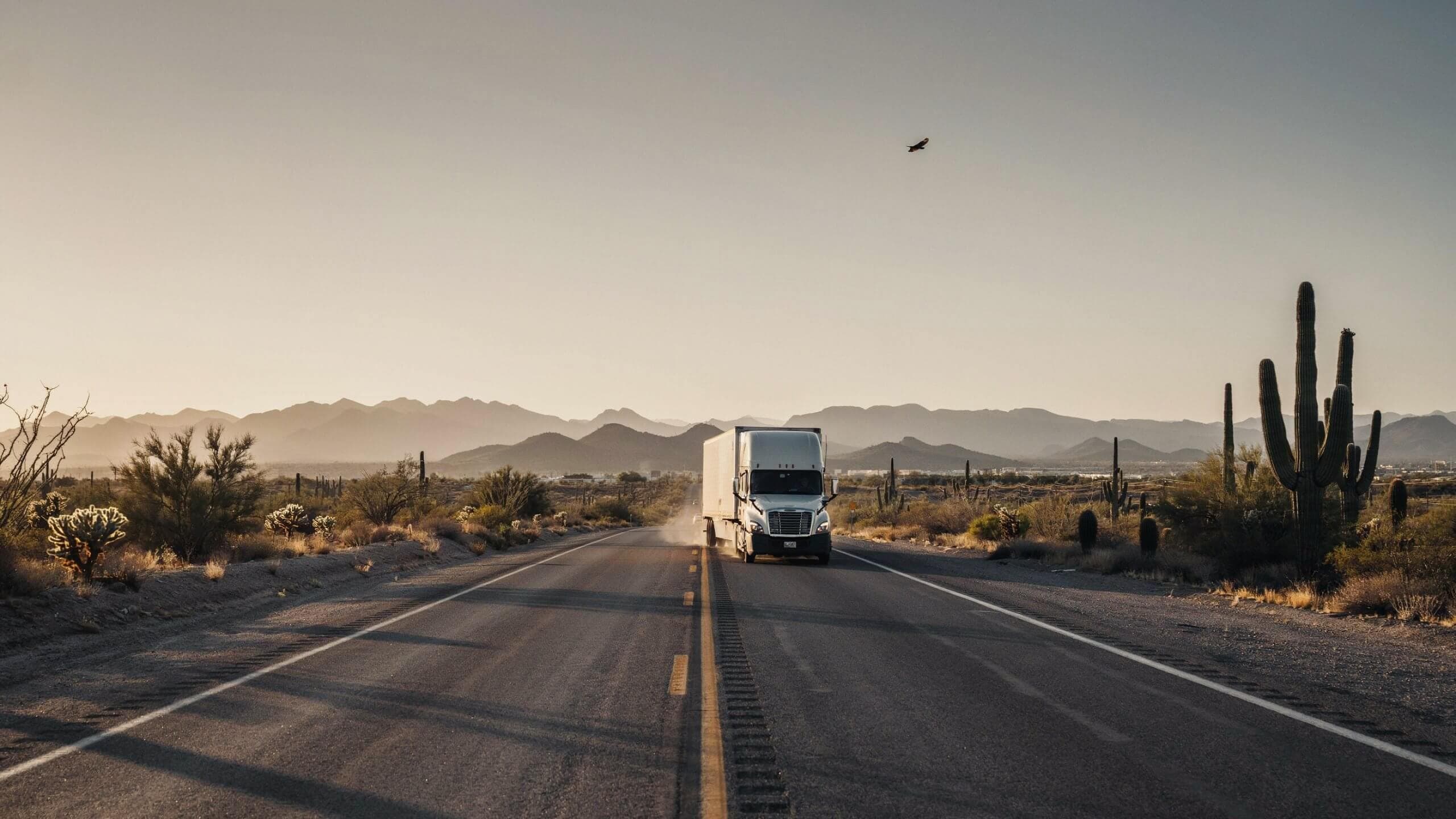
Tucson is not Phoenix, and any guide that treats the two the same is about to cost you money. The Valley is a two-million-driver freight machine with a school on every corner. Tucson is a tighter, quieter market with fewer options, a couple of very specific niches, and one funding advantage the Valley cannot match. Read this as a decision brief, not a brochure.
Here is the uncomfortable part up front: Southern Arizona has a scarcity problem. There are only a handful of legitimate CDL training options inside Pima County, and when a school runs a full class or lets a program lapse, your realistic choices narrow fast. That scarcity is also the opportunity. The drivers who understand what Tucson actually hauls — and who lock in the right funding before signing anything — walk into a market that is short on people and long on freight.
This piece has one job: help you decide whether to get your Class A here in Tucson or make the 100-mile move to Phoenix. Everything else is in service of that call. If you want the statewide mechanics — MVD, the Authorized Third Party system, the CLP timeline — start with our Arizona CDL master guide and come back.
1. The Tucson bet
Forget the generic "trucking is booming" line. Tucson's freight economy runs on three concrete engines, and each one hires a different kind of driver. If your training doesn't point at one of these, you are training blind.
Niche one: the Nogales produce pipeline
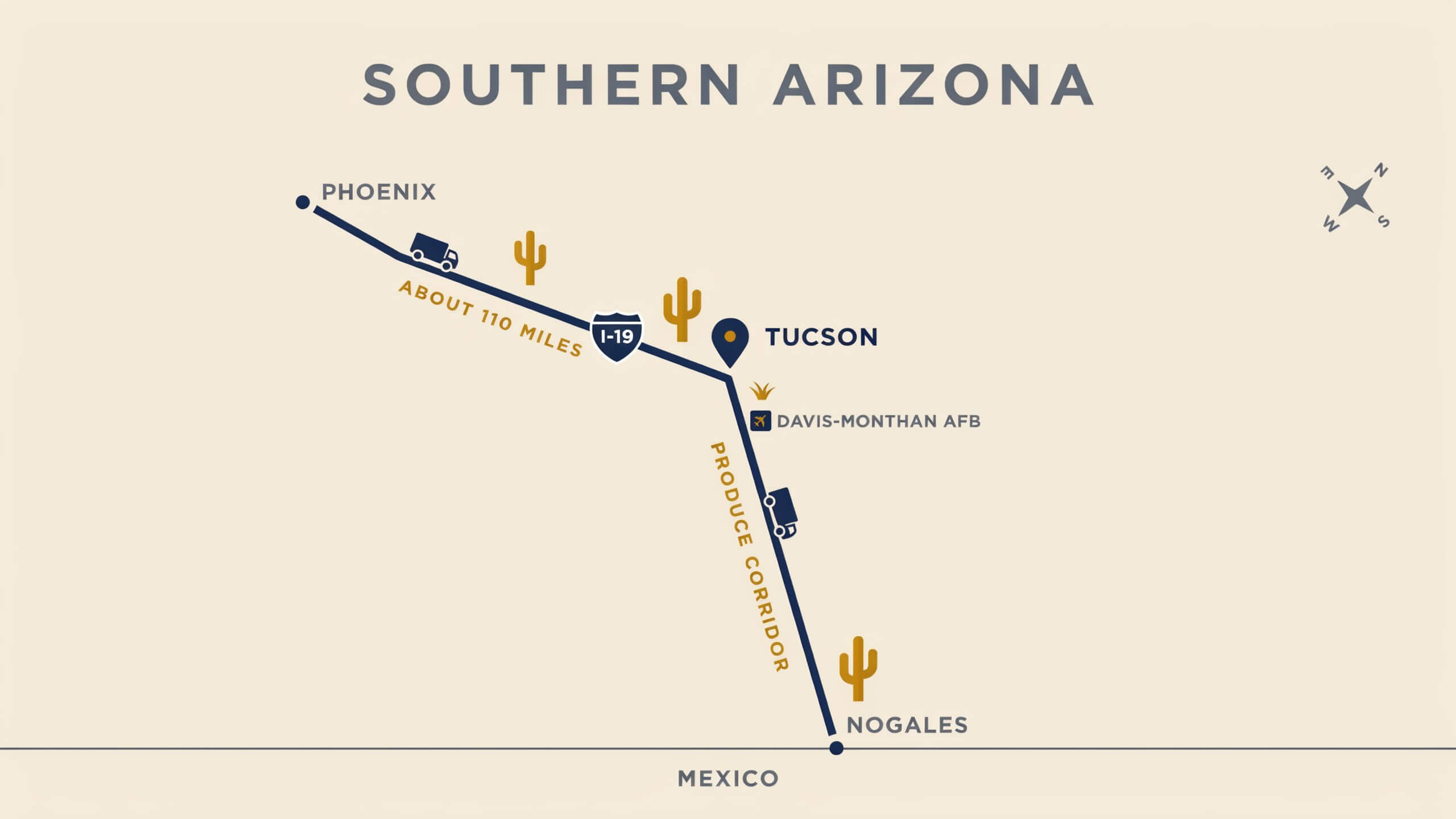
Sixty miles south on I-19 sits Nogales, the busiest fresh-produce port of entry on the entire southern border. Tomatoes, peppers, cucumbers, berries, table grapes — a staggering share of the winter produce eating on American tables crosses here and gets trucked north through Tucson. This is reefer (refrigerated) work, it is seasonal, and it is the single most Tucson-specific opportunity on this list.
Niche two: the Davis-Monthan and veteran channel
Tucson is a military town. Davis-Monthan Air Force Base anchors a deep pool of separating service members and veterans, and that changes the economics of getting licensed here (more on that in Section 2). It also feeds a steady stream of disciplined, drug-screen-clean candidates that local carriers actively recruit. If you are a veteran, Tucson is arguably a better launch pad than Phoenix.
Niche three: the I-10 through-freight corridor
I-10 is the artery. It links the Los Angeles / Long Beach ports to El Paso, Texas, and everything east. Tucson sits directly on it, which means dry-van OTR and regional runs are the bread-and-butter baseline job here — reliable, always hiring, and the easiest first seat to land while you build experience for the higher-paying niches.
| Niche | Where the freight is | What you actually haul | Who it fits |
|---|---|---|---|
| Nogales produce | I-19 south / border ports | Reefer loads, time-sensitive, seasonal (peaks winter) | Drivers who want home-region runs and don't mind the seasonal swing |
| Veteran / base channel | Davis-Monthan & Tucson metro | Local, LTL, government-adjacent and carrier fleets | Separating military, veterans, GI Bill users |
| I-10 through-freight | The I-10 corridor (LA to El Paso) | Dry van, regional and OTR, always hiring | New CDLs who need a first seat and steady miles |
Notice what this table is not: it is not a ranking of schools. It is a map of demand. Your school is a means to an end, and the end is one of these three columns. Pick the column first.
Time your graduation to the produce calendar
The Nogales produce season runs heavy from roughly November through May, with the crossings swelling in the winter months. If reefer work is your target, the smart play is to be licensed and job-ready by late fall — walking into the market in October or November means you hit the hiring surge, not the summer lull. A driver who finishes in June has to wait out the slow season. Timing is free leverage; use it.
2. Tucson's real edge: funding
This is the section that should keep you in Tucson, and it is the one most guides skip. The Valley has more schools; Southern Arizona has a better funding stack for a lot of people. Two pipelines matter.
WIOA through Arizona@Work Pima County. The federal Workforce Innovation and Opportunity Act money flows to Pima County the same way it flows to Maricopa. If you are laid off, low-income, or receiving benefits like SNAP, WIOA can cover a large share — often effectively all — of an approved CDL program. The catch is bureaucratic, not financial: you must apply and get approved before you sign a school contract, and the intake takes a few weeks. Start at an Arizona@Work Pima center before you do anything else. We break the whole money picture down in the Arizona CDL cost and free-training guide.
The GI Bill, and this is where Tucson pulls ahead. Because Davis-Monthan sits inside the city, Southern Arizona has an unusually large population of GI Bill-eligible veterans and separating service members. An approved CDL program can be paid through VA education benefits, and that stacks with the veteran-friendly hiring described in Section 1. If you are eligible, this single fact can decide the whole "stay or go" question — you are not chasing tuition, and local carriers want to hire you. That combination is stronger here than up north.
Straight talk: Funding is only "free" if you sequence it correctly. Apply for WIOA or confirm your VA benefit certificate first, get the approval in writing, then enroll. Pay cash up front expecting a reimbursement later and you will often be disappointed. The paperwork order is the whole game.
The requirements to even qualify for a permit are statewide and non-negotiable — age 18 for intrastate and 21 for interstate or Hazmat, a held regular license for a year, and the 14-day CLP wait before your skills test. Confirm you clear all of them in the Arizona requirements and permit-manual guide before you spend a dollar on training.
3. The big decision: train here or drive to Phoenix?
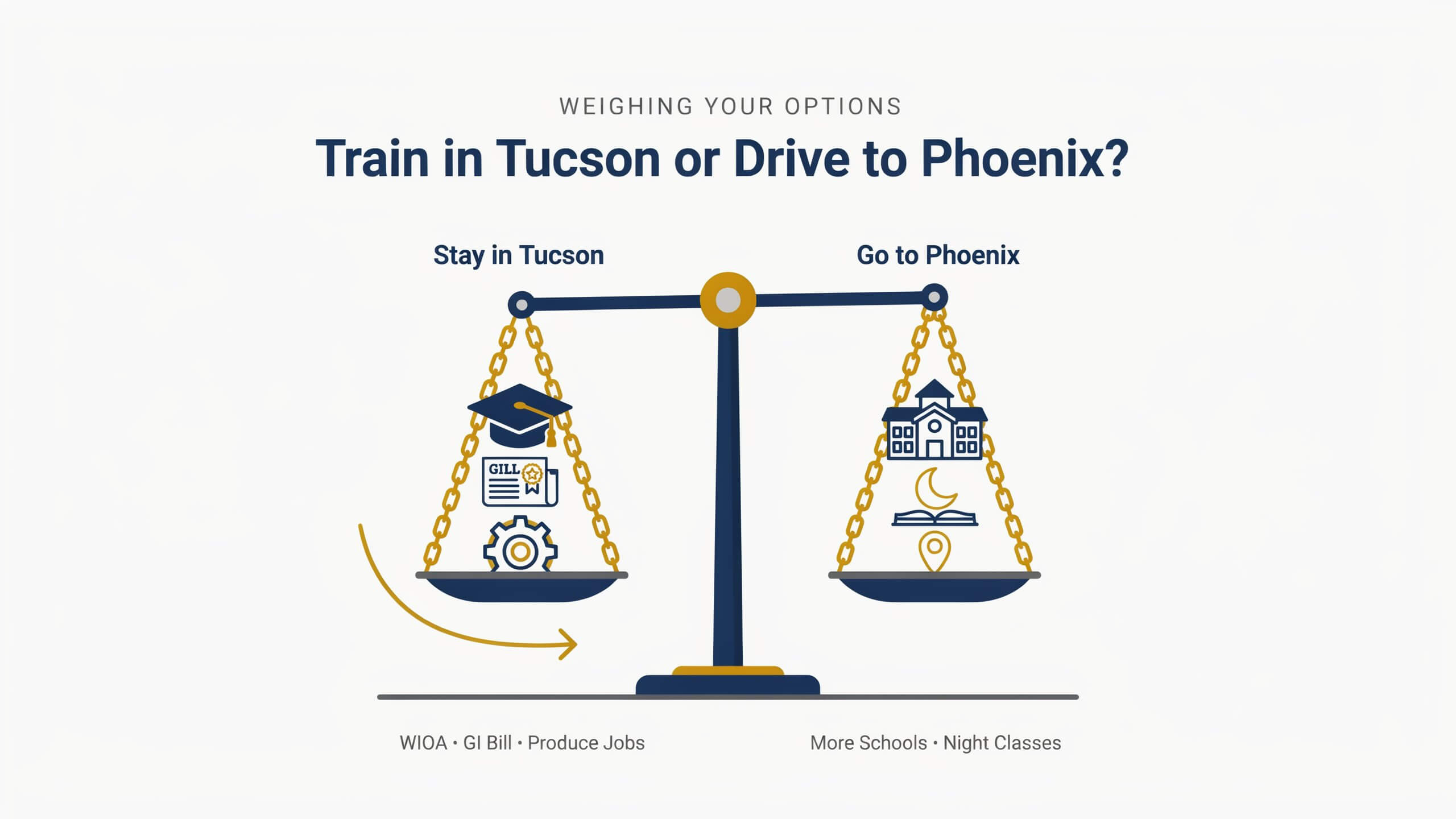
Here is the spine of this whole brief. Phoenix, 100 miles up I-10, has more schools, more class dates, and more brand-name carriers headquartered locally. Tucson has fewer options but shorter commutes, cheaper living, the veteran advantage, and those specific southern niches. There is no universal right answer — there is your answer, and it depends on which line below describes you.
| Stay in Tucson if… | Go to Phoenix if… |
|---|---|
| You are a veteran or GI Bill-eligible — the funding-plus-hiring combo is strongest here. | The Tucson programs are full, waitlisted, or your target start date isn't offered. |
| You want to work the Nogales produce or I-10 regional niches close to home. | You want a specific carrier-sponsored path (several giants are HQ'd in the Valley). |
| You have local WIOA (Pima) approval that ties to a Tucson provider. | You need a night or weekend schedule Tucson doesn't offer, or the fastest possible start. |
| Your roots, housing, and family are in Tucson and moving is a real cost. | You plan to relocate to the Valley for work anyway — then train where you'll live. |
| You want mountain-grade experience close by; you can train on real Southern Arizona terrain. | You want the deepest bench of school choices and can absorb higher living costs. |
If you land in Phoenix territory, do it deliberately — read the Phoenix CDL schools guide and treat it as a relocation, temporary or permanent, not a daily errand. Which brings us to the trap.
Don't Get Burned Here: the I-10 super-commute
The single worst plan we see is students who keep living in Tucson and try to drive I-10 up to a Phoenix school and back every day. That is roughly 200 miles round-trip and 3 to 4 hours behind the wheel before you've done a minute of training. In summer heat, on a corridor thick with truck traffic, that grind burns fuel, money, and focus — and exhausted students wash out of skills training at a brutal rate. If Phoenix is genuinely the right call, move up there for the few weeks of the program or find lodging near the school. Do not try to out-tough a 4-hour daily commute; it is a decision, not a hardship badge.
4. Your local options, briefly
This is intentionally short, because the point of this brief is the decision, not a school beauty contest. Tucson's legitimate training generally falls into two buckets, and both can be excellent depending on your funding and timeline.
- The community college route. A public college program in the Tucson area is the classic "smart shopper" option — Title IV financial aid eligibility, structured hours, and typically a lower sticker price than private schools. The trade-off is pace and calendar: cohorts fill early and the schedule is less flexible. If a public program lines up with your WIOA approval and your target start month, it is hard to beat on cost.
- Private CDL schools. Independent providers tend to move faster — shorter programs, more start dates, sometimes evening or weekend options — at a higher price, generally in the several-thousand-dollar range for Class A. This is where WIOA or GI Bill funding does the heavy lifting; paying full private tuition in cash is a lot to swallow.
We are naming buckets, not schools, on purpose — no rankings, no endorsements. The Tucson market is small enough that availability shifts month to month, so the only reliable move is to check the current, vetted list rather than trust a name someone mentioned last year. Pull up our directory of CDL schools in Tucson for who is actually enrolling right now.
CAUTION: scarcity cuts both ways
Because there are only a handful of real options in Pima County, a single full cohort can push your start date back by weeks. Call two or three providers the same week and ask for their next start date, not just the soonest one advertised. Availability, not marketing, should drive your shortlist.
5. Vetting in 60 seconds
Whatever you choose, screen it fast with these non-negotiables. This takes one phone call.
- ELDT provider on the federal registry. Entry-Level Driver Training is federally mandatory, and your school must be listed on the FMCSA Training Provider Registry. If they're not on it, your training doesn't count. This is a hard yes/no — verify it yourself, don't take their word.
- Third-Party Testing. Ask directly: "Do you administer the skills test in-house as an authorized third party, or do I test at the MVD?" In-house third-party testing means you test where you trained, on equipment you know — a real advantage over a cold MVD lot.
- Manual vs. automatic. This one bites rookies. Test in an automatic transmission and your CDL carries a restriction barring you from manual trucks. Plenty of carriers still run manuals, and plenty don't care — but you should choose the restriction knowingly, not discover it after graduation. Ask which transmission you'll test on.
- Real terrain. Confirm you'll drive actual highway and grade, not just a flat practice pad. Southern Arizona has climbs; your first job may have more.
That's the whole screen. Registry, testing, transmission, terrain. Any school that gets cagey on those four is telling you something.
The verdict
For most Southern Arizona drivers — and especially for veterans — staying in Tucson is the sharper play than most people assume. The GI Bill-plus-Davis-Monthan hiring combo, the Pima WIOA money, and the produce and I-10 niches add up to a market that quietly rewards the people already here, without the Valley's higher cost of living. Phoenix wins on sheer volume of choices, and if your program is full or you're relocating anyway, go — deliberately, with lodging sorted, never as a daily I-10 grind. Tucson isn't the consolation prize to Phoenix. Play it right and it's the better hand.
Next move: see who is actually enrolling in Southern Arizona right now — browse the vetted list of CDL schools in Tucson, then confirm your funding before you sign anything.
Official resources: ADOT Commercial Driver License and the FMCSA CDL program.
Ready to Find CDL Schools?
Search for CDL training programs in your area. Start your journey to becoming a professional truck driver today.
Find CDL Schools Near YouRelated Articles
Arizona CDL Cost & Free Training (2026): The Real Price Breakdown + WIOA/GI Bill
The sticker price on a Class A CDL is not the number that empties your bank account. Here is the true all-in cost of getting licensed in Arizona in 2026, line by line, plus every path to getting it paid for through WIOA, the GI Bill, and Pell.
CDL Schools in Phoenix (2026): How to Choose (and Vet) the Right One
A dozen Phoenix schools want your enrollment and telling them apart is the real work. A buyer's guide to the three school types, the red flags that signal a diploma mill, and the 8 questions to ask before you sign.
How to Become a Truck Driver in Arizona (2026): From Class C to CDL
A month-by-month roadmap from your plain Class C license to a home-daily driving job in Phoenix. What each stage actually costs, how long it takes, and where the money hides.