
How to Become a Truck Driver in Arizona (2026): From Class C to CDL
A month-by-month roadmap from your plain Class C license to a home-daily driving job in Phoenix. What each stage actually costs, how long it takes, and where the money hides.
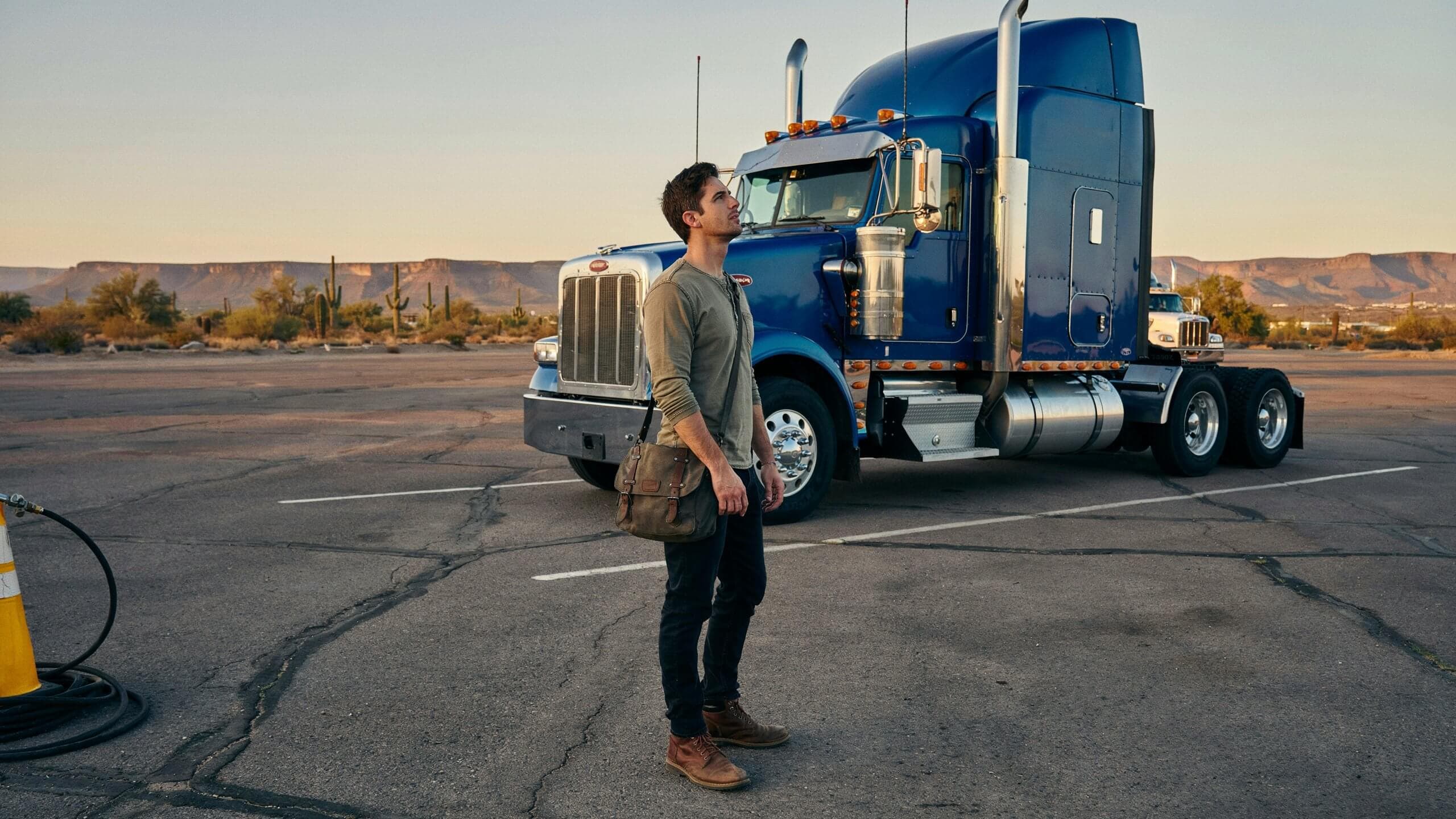
Right now you hold a plain Arizona Class C license, the same one that gets you to the grocery store. Twelve to eighteen months from now, if you follow the road below, you could be climbing into a truck before sunrise, running a local Phoenix route, and clocking out with the kind of paycheck that used to require a college degree. This is the whole journey, laid out in the order you will actually live it.
Nobody hands you a career in one afternoon at the MVD. Becoming a truck driver in Arizona is a sequence of gates, and each gate has a clock on it. The permit has a mandatory 14-day wait. School runs three to six weeks. Your rookie year is a grind that most people misunderstand before they start. So instead of a checklist, treat this as a calendar. Let's walk it forward in time, week by week and month by month, so you know exactly where you stand at every stage.
1. Is This Even For You? The Honest Reality of the Job
Before you spend a dollar, get clear on what you are actually signing up for, because the trucking life splits into two very different worlds and picking the wrong one is how people wash out in year one.
The first world is OTR (Over-The-Road). You live in the truck for two, three, sometimes four weeks at a stretch, crossing state lines, sleeping in the sleeper berth, showering at truck stops. Most starter jobs with the big national carriers are OTR, because that is where a rookie with zero experience can get hired the fastest. The trade-off is your life goes into a 10-foot cab.
The second world is local and home-daily. You start early, run routes inside the Valley or around Arizona, and you sleep in your own bed every night. This is what most people actually want. The catch nobody tells you upfront: the good home-daily jobs almost never hire a driver with a fresh CDL and no miles. You usually have to earn your way into them, which is exactly why the timeline below matters.
Straight Talk: Arizona is one of the best states in the country to do this. Phoenix sits between the ports of California and the rest of the nation, so freight never stops moving. The heat is brutal and the I-17 mountain grades north of the Valley are no joke, but demand for drivers here is deep and steady. If you can handle a 115°F yard and a 3 a.m. alarm, the work is waiting.
CAUTION: Be honest about the lifestyle before you spend money.
If a two-week stint away from home would end your marriage or leave nobody to watch your kids, an OTR-only starter path will break you fast. Know that going in, because your very first job will almost certainly be the least flexible one of your career. It is a bridge, not a destination.
2. First, the Fork in the Road: Class A or Class B
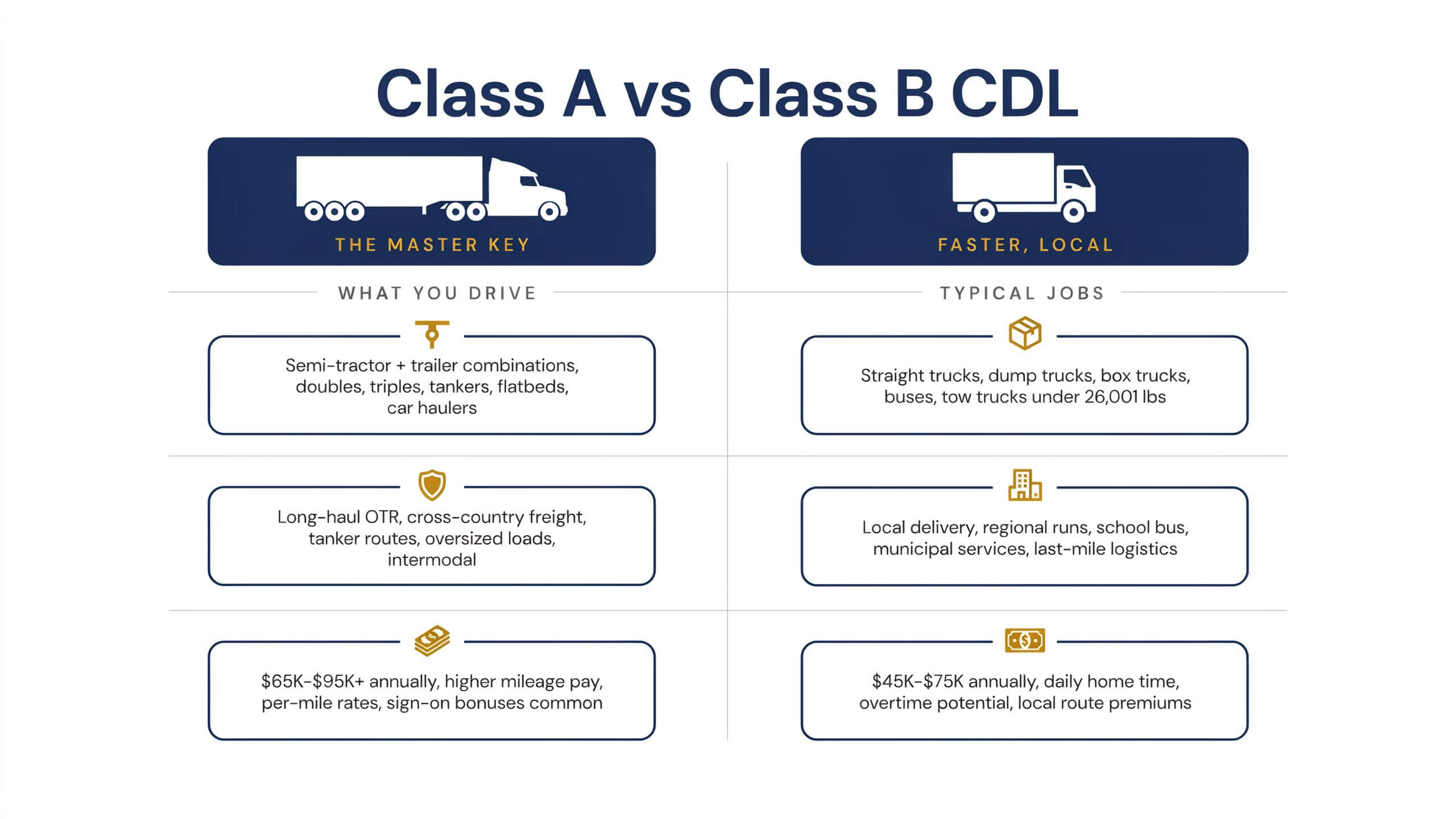
Your very first real decision comes before you ever touch a truck, and most people never think it through. You have to choose which CDL to chase: Class A or Class B. This single choice shapes your school, your cost, and the jobs that open up for you.
A Class A license lets you drive combination vehicles, meaning a tractor pulling a trailer, semis, tankers, doubles. It is the master key. Almost everything a Class B driver can do, a Class A driver can do too, plus long-haul freight, flatbed, and the heavy hauling. A Class B license covers single heavy vehicles, box trucks, dump trucks, buses, and most local beverage and delivery rigs. It is faster and cheaper to earn, but it boxes you out of the highest-paying combination work later.
| Factor | Class A (Combination) | Class B (Single Vehicle) |
|---|---|---|
| What you can drive | Semis, tankers, flatbed, doubles, plus most Class B rigs | Box trucks, dump trucks, buses, straight beverage trucks |
| School length (typical) | 4 to 6 weeks | 3 to 4 weeks |
| Private-school cost (2026) | Around $4,000 to $7,000 | Often $2,500 to $4,500 |
| Realistic AZ first-year pay | Roughly $48,000 to $62,000 | Roughly $45,000 to $58,000 |
| Realistic AZ pay, experienced | Roughly $70,000 to $95,000+ | Roughly $60,000 to $85,000 |
| Best for | Maximum options and long-term ceiling | Staying local, fastest entry, dump and beverage work |
My blunt take: unless you already have a specific local Class B job lined up and promised, get the Class A. It costs a bit more time and money up front, but it keeps every door open. A Class A holder can always take a Class B job; a Class B holder who later wants combination work has to go back to school. Pay the tuition once. The pay ranges above are deliberately cautious for the Arizona market as of 2026, and your actual number depends heavily on the niche you land in, which we get to in Section 6.
3. Weeks 1–2: Permit and Medical Card
Your clock starts here. Weeks one and two are pure paperwork and studying, and there is a hard legal wait baked in that you cannot shortcut, so start now.
Two things happen in parallel. First, the DOT medical card. Federal rules through the FMCSA require you to pass a physical from a certified medical examiner, which usually runs $80 to $100 at a place like Concentra. The Arizona-specific trap is that the paper certificate is useless until you upload it to your MVD record; the clerk cannot advance you until the system shows "Certified." Do this on day one, because if your BMI or blood pressure flags a follow-up, you want that delay happening now, not later.
Second, the CLP (Commercial Learner's Permit). You study for and pass the written knowledge tests, then pay the $25 permit fee. In Arizona you can do this at an Authorized Third Party (ATP) office instead of standing in the government MVD line, and it is worth the small convenience fee. Before you walk in, make sure you meet the basics: you must have held your regular license for a year, be 18 for intrastate driving or 21 for interstate, and pass a vision screen.
Worth Knowing: Once your CLP is issued, federal law forces a 14-day wait before you can take your skills test. That two-week clock is exactly why Section 4 lines up the way it does. Get your permit in hand at the start of Week 1 and the wait quietly runs out while you are busy in school.
Do not walk into the ATP cold. Read the full eligibility and document rules first in our Arizona CDL requirements and permit manual guide, and grind the knowledge sections until you can pass them in your sleep. The big three, General Knowledge, Air Brakes, and Combination, are entirely learnable with a couple of solid weeks of practice questions. For the wider Arizona process, the full Arizona CDL guide covers the ATP shortcut in detail.
4. Weeks 3–6: Truck-Driving School
With the permit in your pocket, weeks three through six are where you actually learn to drive the thing. This is also the stage where the most money is on the line, so choose deliberately.
Federal ELDT (Entry-Level Driver Training) rules require you to train with a provider listed on the official Training Provider Registry, so any legitimate Arizona school will be registered; if a school is not on the registry, walk away. Beyond that, you are really choosing between two funding models, and this choice follows you for a year.
- Sponsored (company) training: A carrier pays for your school in exchange for a contract, usually a year of driving for them. Zero cash up front, but you are locked in, and quitting early can mean owing thousands.
- Private or community-college school: You pay tuition yourself (or with a grant), then you are free to work for anyone the day you graduate. More flexibility, more upfront cost.
Which is right depends entirely on your cash situation and your tolerance for a contract. I have laid out the full trade-off, including the fine print people miss, in sponsored training vs private school. Read it before you sign anything, because a sponsored contract is a legal commitment, not a favor.
The good news for Arizona residents: you may not have to pay a private-school bill at all. Between WIOA funding through ARIZONA@WORK in Maricopa and Pima counties, GI Bill benefits for veterans, and Pell eligibility at Title IV community colleges like Pima or Central Arizona, a lot of students graduate debt-free and contract-free. That is the best of both worlds: private-school flexibility on someone else's dime. The full breakdown of what each option really costs and how to qualify lives in the Arizona CDL cost and free training guide.
Two questions to hammer any school with before enrolling: "Are you a third-party tester?" (if yes, you test on-site instead of at a strange MVD lot) and "Do we train on real mountain grades?" Arizona's I-17 climb toward Flagstaff is where cheap flat-only training gets rookies in trouble on their first real load. Schools like Southwest Truck Driver Training, Phoenix Truck Driving Institute, and the community colleges are common Arizona names to compare; shop them the way you would shop a used car.
5. Months 2–6: Your Rookie Year Begins
You passed the skills test, paid your $25 license fee, and you are officially a CDL holder. Now comes the part that humbles everyone. Months two through six are your rookie stretch, and understanding how you get paid here is what separates the drivers who stick from the ones who quit angry.
Most first jobs pay CPM (cents per mile), not an hourly wage or a salary. A carrier advertising, say, 55 cents per mile sounds great until you realize you only get paid for miles the wheels actually turn. Sitting at a shipper for four hours waiting to load? Unpaid, unless there is detention pay. Stuck in Phoenix rush-hour traffic? Those slow miles pay the same as easy ones. Repositioning to your next load? Often unpaid "deadhead." The advertised CPM is a headline number, and your real take-home depends entirely on how many paid miles the company can actually keep under you.
This is the biggest reason rookies feel lied to, and I unpack the whole mechanism, with the math, in the CPM salary reality. Read it before you accept an offer, so a recruiter's "up to 60 CPM" pitch does not fool you.
CAUTION: The "home daily" bait for rookies.
A recruiter promises a fresh CDL holder a home-daily local job, and it sounds like you skipped the hard part. Look closer before you celebrate. These rookie local jobs are often the lowest-paying seats a company has, sometimes dedicated night runs or backbreaking unload work priced below what the OTR side earns. Real home-daily money comes from experience and a clean record, not from your first week. Take the local job if it fits your life, but do it with your eyes open about the pay, not because it sounds easy.
My advice for this stretch: treat your first job as tuition for your record, not as the payoff. Six to twelve months of a clean, incident-free driving history is the currency that buys you into the good jobs next. Show up, run safe, keep your logs clean, and do not job-hop. That boring consistency is what unlocks Section 6.
6. Months 6–18: Climbing to the Good Jobs
Somewhere around month six, with real miles behind you and a clean record, the market flips. Now you are the one with options, and Arizona has some genuinely well-paying local niches that only hire drivers who have proven themselves. This is where the career you actually pictured starts.
Two Phoenix specialties stand out. Beverage delivery (think Hensley/Budweiser, Crescent Crown, Swire Coca-Cola) is hard physical work because you are essentially the forklift, but it is local, home-daily, and often pays $75,000 to $90,000 once you are experienced. Belly-dump and end-dump construction hauling feeds Arizona's endless road and housing boom; it is early, dirty, and mostly forward-drive-and-dump instead of nerve-wracking dock backing, and it pays a strong hourly rate. Food-service hubs like Shamrock Foods and Sysco round out the top-tier local options.
| Stage | Typical Job | Lifestyle | Realistic AZ Pay (2026) |
|---|---|---|---|
| Months 2–6 (Rookie) | OTR or dedicated CPM freight | Weeks away from home | Around $48,000 to $58,000 |
| Months 6–12 | Regional / dedicated lanes | Home weekly, some nights | Around $58,000 to $70,000 |
| Months 12–18 | Local beverage, dump, food service | Home daily, early starts | Around $70,000 to $90,000 |
| 18+ months | Tanker, Hazmat, specialized haul | Home daily/weekly, premium | Often $85,000 to $100,000+ |
Endorsements Are a Pay Multiplier
Every endorsement you stack widens the pool of higher-paying jobs you qualify for. A Tanker (N) endorsement opens fuel and liquid hauling. Combine it into a Tanker + Hazmat (X combo) and you become eligible for some of the best-paid local seats in Phoenix, a genuine fuel-and-chemical hub. The fees are almost trivial next to the earning bump: an endorsement is roughly $10, the combined X test around $20, the required Hazmat TSA background check about $85, and a TWIC card (handy for port and rail work) around $125. Spend a few hundred dollars total and you can add real money to your annual pay. Add these once you have a clean record and know which niche you want.
Where You'll Be in 12 Months
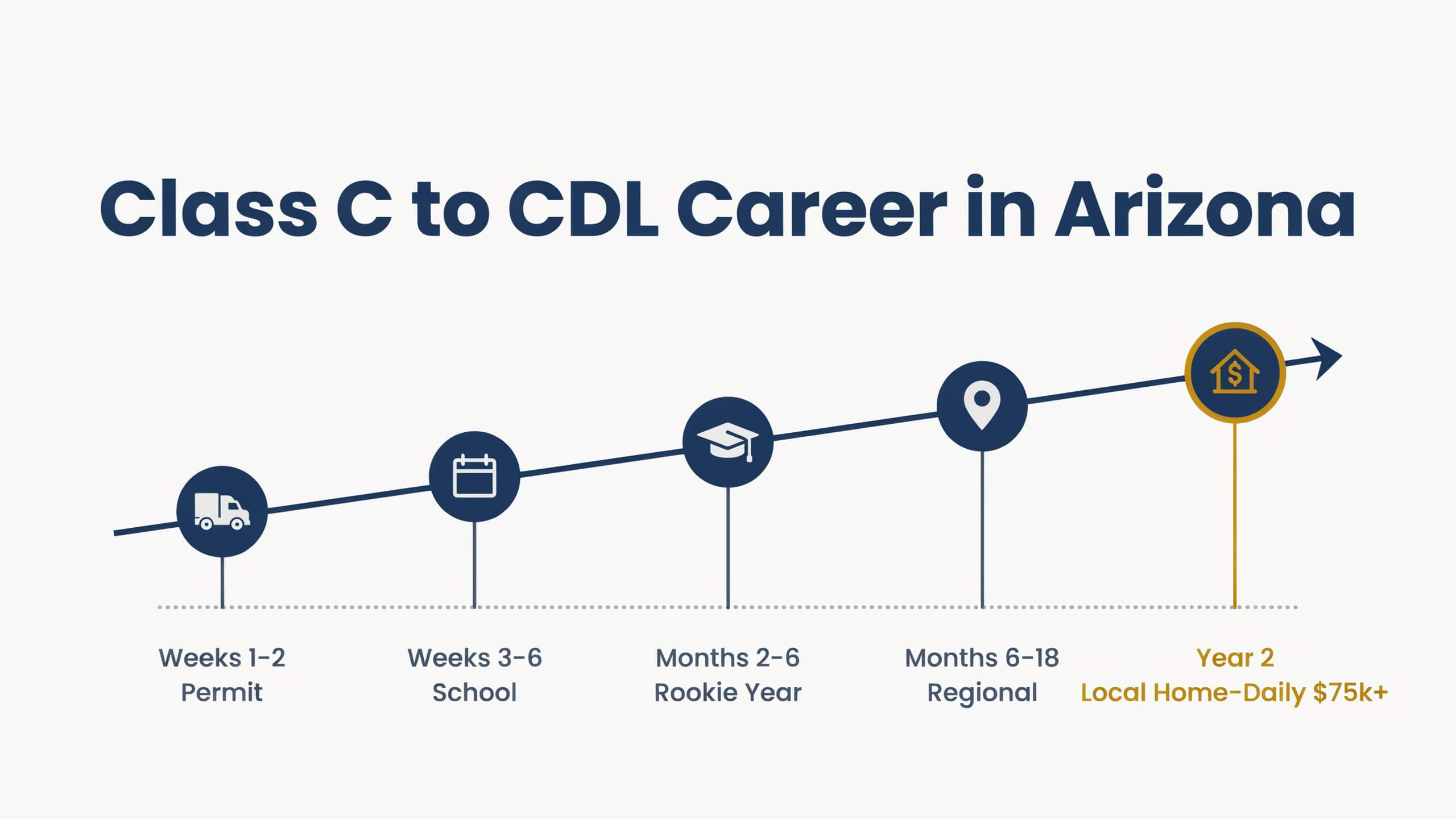
Picture the version of you exactly one year from the day you upload that first medical card. If you moved through these gates without stalling, you are no longer the nervous beginner sweating a 90-degree alley dock. You have a Class A CDL, six to twelve months of clean miles on your record, and a resume that local Phoenix employers actually take calls about. The OTR grind that felt endless in month three is now the very thing that qualifies you for the home-daily beverage or dump job you wanted all along. You are sleeping in your own bed, starting early, and earning well into the fifties or sixties with a clear line of sight to $75,000-plus as you stack experience and an endorsement or two.
None of that is luck. It is just the calendar below, run one gate at a time.
- Weeks 1–2: DOT medical uploaded and certified, CLP in hand, 14-day clock ticking.
- Weeks 3–6: ELDT school done, funding secured, Class A skills test passed.
- Months 2–6: First CPM job, clean record building, learning how you really get paid.
- Months 6–12: Move up to regional or dedicated lanes, home more, pay climbing.
- Months 12–18: Land the local home-daily seat, add endorsements, break into the top pay tiers.
Start the clock this week. Nail down your eligibility and paperwork in the Arizona requirements guide, then browse vetted programs on our list of CDL schools in Phoenix. For the official rules straight from the source, see the ADOT commercial driver license page and the FMCSA CDL requirements. Twelve months from now, the only regret you will have is not starting sooner.
Ready to Find CDL Schools?
Search for CDL training programs in your area. Start your journey to becoming a professional truck driver today.
Find CDL Schools Near YouRelated Articles
CDL Schools in Phoenix (2026): How to Choose (and Vet) the Right One
A dozen Phoenix schools want your enrollment and telling them apart is the real work. A buyer's guide to the three school types, the red flags that signal a diploma mill, and the 8 questions to ask before you sign.
Arizona CDL Cost & Free Training (2026): The Real Price Breakdown + WIOA/GI Bill
The sticker price on a Class A CDL is not the number that empties your bank account. Here is the true all-in cost of getting licensed in Arizona in 2026, line by line, plus every path to getting it paid for through WIOA, the GI Bill, and Pell.

Arizona CDL Practice Test (2026): Real Sample Questions, Answers & the 80% Math
Stop reading study guides and start answering questions. Ten representative Arizona CDL sample questions with answers explained, plus the 80%-per-module math and a skip strategy that tells you exactly which tests to take.