
Arizona CDL Cost & Free Training (2026): The Real Price Breakdown + WIOA/GI Bill
The sticker price on a Class A CDL is not the number that empties your bank account. Here is the true all-in cost of getting licensed in Arizona in 2026, line by line, plus every path to getting it paid for through WIOA, the GI Bill, and Pell.
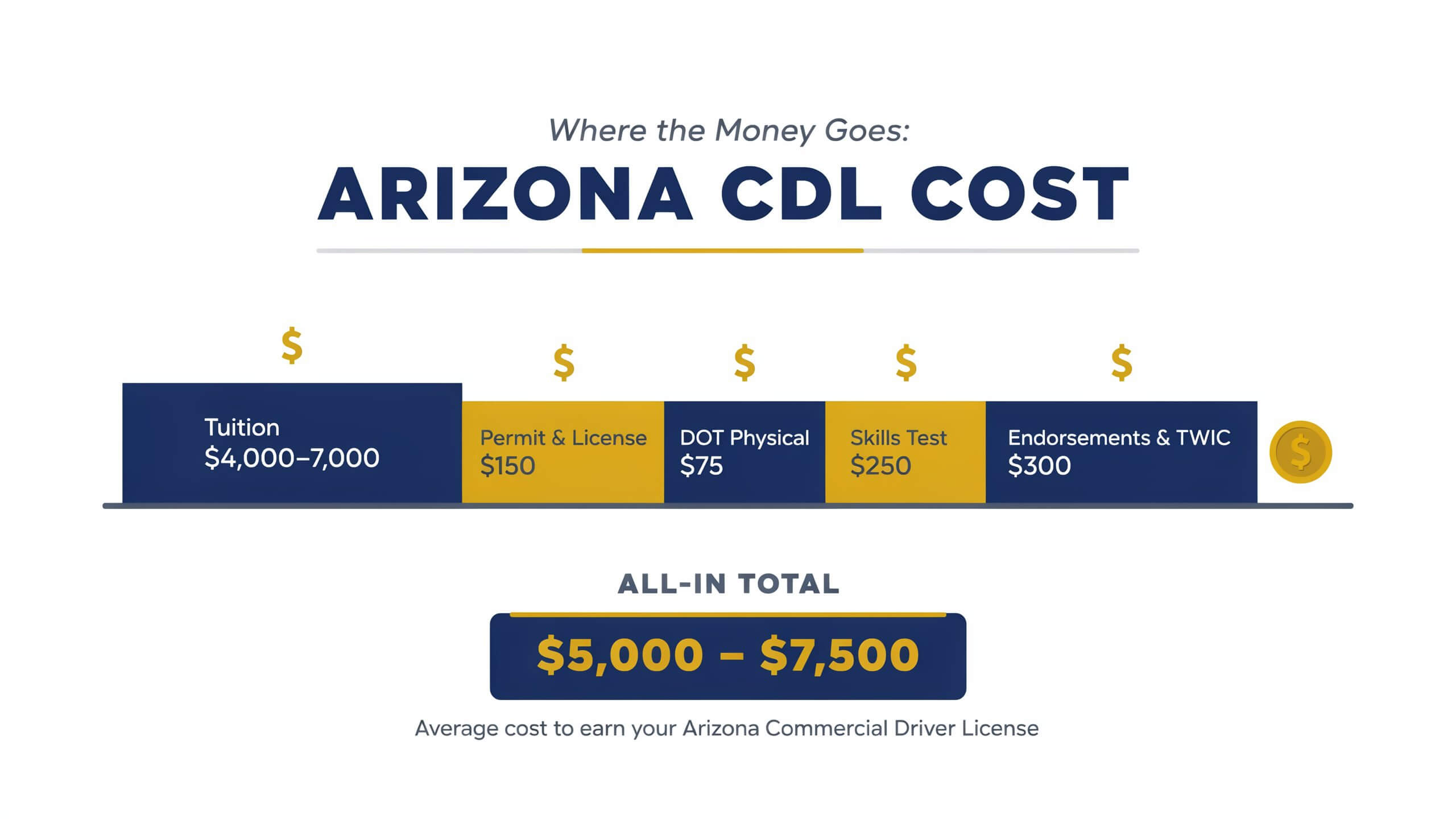
The tuition number a school quotes you is not the number that clears your bank account. The real all-in cost of an Arizona Class A CDL in 2026 lands closer to $5,000–$7,500 out of pocket once you add the fees nobody puts on the flyer.
So before I explain anything, here is the whole thing on one screen. This is the line-by-line breakdown of what it actually costs to walk out with a Class A license in Arizona, as of 2026. Read the table first, then I will take it apart row by row.
| Line Item | Typical 2026 Cost | Who Charges It |
|---|---|---|
| Tuition (Class A, private school) | around $4,000 – $7,000 | Your training provider |
| CLP (Commercial Learner's Permit) | $25 | Arizona MVD / ADOT |
| DOT Physical (medical card) | around $80 – $150 | Certified medical examiner |
| CDL License fee | $25 | Arizona MVD / ADOT |
| Skills test — State (MVD) | $25 | Arizona MVD (long wait) |
| Skills test — Third Party / ATP | around $150 – $400 | Authorized Third Party tester |
| Endorsements (each: Tanker, Doubles, etc.) | around $10 each | Arizona MVD / ADOT |
| Hazmat — TSA background check | around $85 | TSA / IdentoGO |
| TWIC card (ports / secure facilities) | around $124 | TSA |
| Retests (if you fail a skills or written test) | $25 – $400 per attempt | MVD or ATP |
| Supplies (gloves, boots, logbook, study apps) | around $100 – $200 | You |
| REALISTIC ALL-IN (private, no funding) | around $5,000 – $7,500 | Before any grant or benefit |
That bottom row is the honest number. Notice what it is not: it is not the "$3,995 special" on the billboard by the I-10. The tuition is the biggest single block, but the government fees, the medical, the skills test, and the endorsements stack another few hundred to a thousand dollars on top. And if you fail one test, that number climbs fast. Now let me dissect it.
1. The all-in number, dissected
Most people budget for tuition and stop there. That is exactly how you end up short $600 the week you were supposed to test. Let me walk the rows that trip people up.
The government fees are cheap — one of them isn't
The state paperwork in Arizona is genuinely inexpensive. Your CLP is $25, your license is $25, and each endorsement runs about $10. If you take your skills test at a regular MVD office, the state test itself is $25. That is the number that floats around forums, and it is correct — for the state test.
Here is the correction almost nobody makes clearly: if you test through an Authorized Third Party (ATP) — which is what your school almost certainly uses so you can skip the MVD line — that skills test is not $25. Third-party testers set their own price, and in 2026 that runs around $150 to $400 depending on the provider and whether the truck rental is bundled in. Budget for the ATP number, not the state number, because the ATP route is the one you will actually use.
Worth Knowing: The $25 you keep seeing quoted is the Arizona MVD skills-test fee. The $150–$400 is what an Authorized Third Party charges for the same test with a faster appointment. Both are real. They are just two different doors, and most students walk through the ATP door. Plan your wallet accordingly.
The medical card and the "small" add-ons
Your DOT physical runs around $80 to $150 at a certified examiner like a walk-in clinic or an occupational-health office. If your BMI or neck size flags you, you can get sent for a sleep study, which is a separate and much larger bill — so know your numbers before you walk in.
Then come the endorsements. Individually they look trivial — about $10 each at the MVD window. The trap is that the $10 is just the MVD line item. Hazmat carries a separate TSA background check of around $85, and if you want to work the ports or secure facilities, a TWIC card adds roughly $124. Those are not endorsements you add for $10; they are federal clearances with their own fees and their own multi-week waits. I break down exactly how those stack in section 5.
For the full sequence of permits, tests, and paperwork behind these fees, our Arizona CDL requirements and permit guide lays out the order of operations, and the broader how to get a CDL in Arizona guide covers the ATP hack in depth.
2. Why the prices vary so much
You will see the same license priced at $3,995 in one ad and $7,200 in another. The license is identical. What differs is the delivery model. There are three, and they price completely differently.
- Private truck-driving schools: Fast (often 3–4 weeks), flexible schedules, and priced around $4,000–$7,000. You pay tuition up front (or via financing, WIOA, or GI Bill). Examples in the Valley include Southwest Truck Driver Training and Phoenix Truck Driving Institute. Price varies with hours, truck time, and whether the skills test is bundled.
- Community colleges (Title IV): Schools like Pima, Central Arizona, Eastern Arizona, and Cochise run CDL programs that are often cheaper because the state subsidizes them, and — this is the part that matters — because they are Title IV eligible, they can accept federal Pell grants. The trade-off is pace: cohorts fill up and terms can run longer than a private four-week sprint.
- Company-sponsored programs: Advertised as "$0 down" or "free." The tuition is real, but it is fronted by a carrier and repaid through your labor under a contract. The price tag is not zero; it is deferred and attached to strings. I put real numbers on this in section 4.
So when two ads look $3,000 apart, you are usually not comparing quality — you are comparing who pays when. That single distinction is what the rest of this article is about.
3. Your path to free
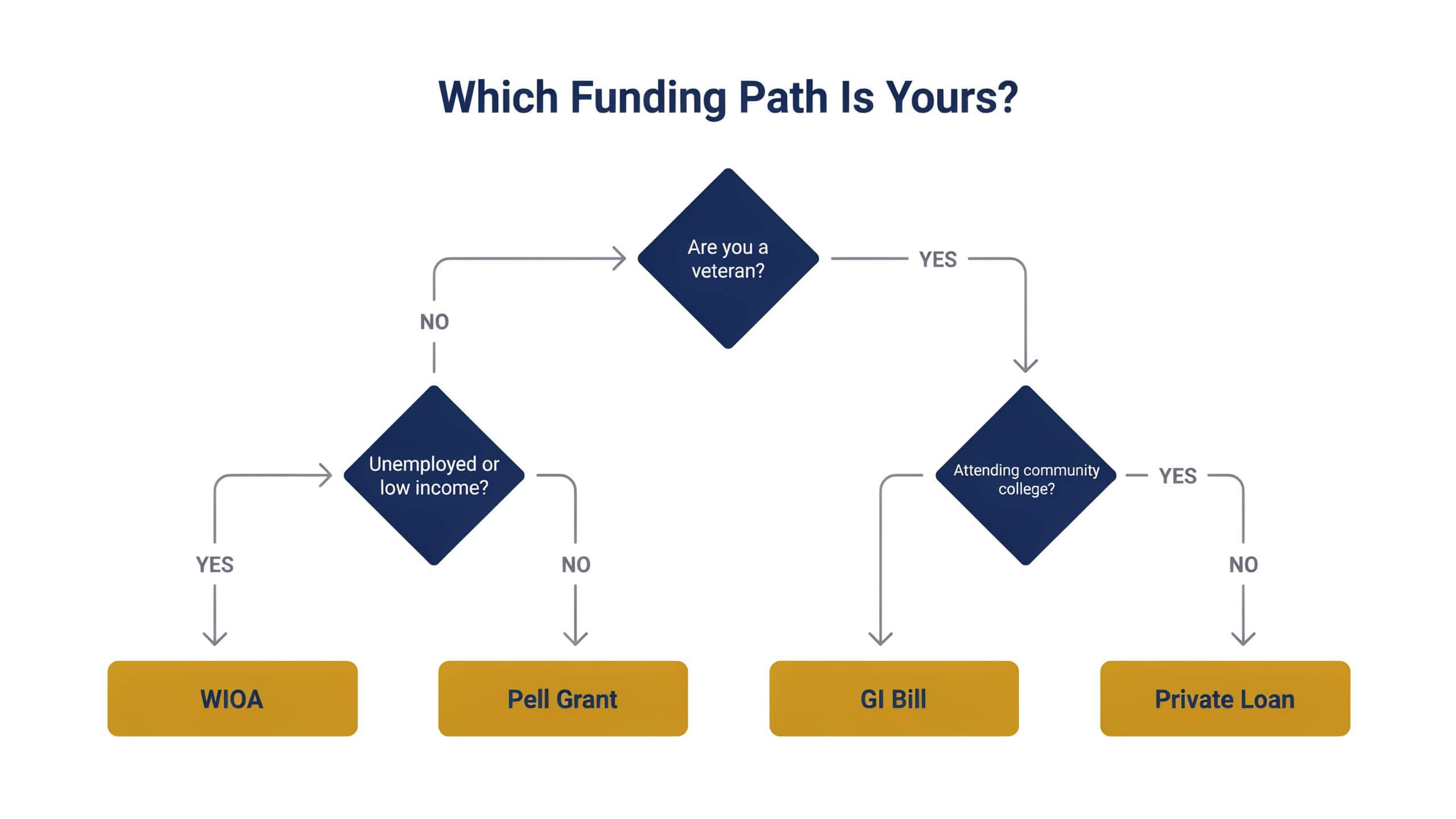
Here is the good news the billboards bury: a large share of Arizona students never pay that $5,000–$7,500 out of pocket. Three funding streams cover it, and which one is yours depends on a couple of yes/no questions. Walk the branches in order.
Branch A — Did you serve? Then GI Bill first.
If you are a veteran or eligible dependent, the GI Bill is almost always your cheapest path for this branch — it can cover tuition at approved CDL programs and, depending on your chapter, add a housing allowance while you train. Start here before you fill out anything else, because a benefit you already earned beats a grant you have to qualify for. Confirm the specific school is on the approved list before you enroll.
Branch B — Unemployed, laid off, or low income? Then WIOA.
This is the big one for Arizona, and it is genuinely generous. WIOA (the Workforce Innovation and Opportunity Act) is federal money administered locally through ARIZONA@WORK. In Maricopa County (Phoenix) and Pima County (Tucson), if you are unemployed, underemployed, low-income, or on benefits like SNAP, you likely qualify to have tuition covered at an approved school.
How the WIOA branch actually works
You start at an ARIZONA@WORK career center (Maricopa or Pima), before you sign any school contract. Expect an orientation, an eligibility review, and a few weeks of lead time — it is not same-day money. But when it lands, you graduate debt-free and contract-free: no carrier owns your first year. Approval is not guaranteed and funds are limited, so apply early. For the honest version of timelines, waitlists, and what disqualifies people, read our WIOA funding reality check.
Branch C — Neither of those, but open to a community college? Then Pell.
If you are not a veteran and do not qualify for WIOA, the federal Pell grant can still cover a chunk — but only at a Title IV eligible school, which in practice means a community college, not a private truck school. Fill out the FAFSA, enroll in an eligible CDL program at a school like Pima or Central Arizona, and Pell can offset tuition without loans.
The Fine Print on Pell: Pell grants generally do not work at private, non-Title-IV truck-driving schools. If a private school tells you to "just use your Pell," be skeptical — most private CDL mills are not Title IV institutions. Pell is a community-college tool. Match the money to the right kind of school or it evaporates.
Branch D — None of the above? Then private, and compare hard.
If you do not fit A, B, or C, you are paying privately. That is fine — just shop the ATP-inclusive price, ask what a retest costs, and confirm the school actually gets you highway and mountain time. Then keep reading, because there is one "free" option built to catch exactly the people in this branch, and it is section 4.
4. The false "free": company-sponsored training
Company-sponsored training is the offer that sounds unbeatable when you are broke: zero down, they train you, they license you, they hand you a job. And for some people it genuinely is the right move. But "free" is doing a lot of lifting in that sentence. You are not skipping the cost — you are financing it with your labor, at terms the carrier sets.
| Factor | Company-Sponsored | Private School + WIOA |
|---|---|---|
| Cash up front | $0 | $0 (grant covers tuition) |
| Contract / commitment | Usually 8–14 months owed | None |
| If you quit early | You owe around $4,000–$7,000+ | You owe nothing |
| Who you can work for | That carrier, at their rate | Anyone — local, OTR, your pick |
| First-year pay leverage | Low (you are "paying off" training) | Market rate from day one |
| Best fit | Broke, need income now, OTR is fine | Eligible for a grant, want local/freedom |
Read the Payback Clause Before You Sign
The dollar sign that hurts on a company-sponsored deal is not on page one — it is the payback clause. Quit, get fired, or wash out at month four, and that "free" training converts into a debt of roughly $4,000 to $7,000, sometimes sent to collections. Meanwhile you have spent those months at reduced pay working it off. If you are grant-eligible through WIOA or the GI Bill, you can get the exact same license with no contract and no clawback. Do not sign a payback agreement until you have first checked whether a grant would cover you for free with no strings. The full side-by-side lives in our sponsored training vs private school breakdown.
None of this makes company-sponsored a scam. It makes it a loan denominated in months of your life. If you have no cash and no grant path, that trade can be worth it. If you have a grant path, taking the contract instead is leaving free money on the table.
5. The hidden costs nobody flyers
Even with tuition handled, three categories quietly drain the budget. These are the ones that turn a $5,000 plan into a $6,500 reality.
Retests
Every failed test costs money to retake. Fail a written knowledge test and you re-pay the fee. Fail the ATP skills test and you can be looking at another $150–$400, plus possibly re-renting the truck. One rough test day can cost more than all your government fees combined. This is why "cheap" schools that rush you to test can end up more expensive than a thorough one.
Endorsements, one at a time
Adding endorsements after the fact means paying, waiting, and sometimes testing again — one at a time:
- Tanker / Doubles-Triples: around $10 each at the MVD, but each is its own written test to study and pass.
- Hazmat: the ~$10 MVD line plus the ~$85 TSA background check plus a multi-week clearance wait before you can even test. Miss the sequence and you delay your start date.
- TWIC: a separate ~$124 federal card if your work touches ports or secure facilities — its own application, its own appointment.
CAUTION: sequence Hazmat before you test, not after.
The TSA Hazmat background check takes weeks to clear. If you decide you want Hazmat after you finish school, you add a separate fee and a separate wait on top of everything. If Phoenix's fuel and chemical routes are your target, start that clearance early so it is not the thing holding up your first paycheck.
Weeks with no paycheck
This is the cost that never appears on any table, and it is often the biggest. Whether your program is three weeks or ten, you are usually not earning while you train. Rent, food, and bills do not pause. Budget for your living expenses across the full training window as if it were another tuition line, because functionally it is. A "free" WIOA-funded course still requires you to survive three-plus weeks with reduced or zero income — plan that cushion, or the money problem you solved on tuition reappears as a rent problem in week two.
The cheapest path for YOUR situation
There is no single "cheapest" answer — the cheapest path depends on who you are. Match yourself to the row that fits, in this order, and take the first one you qualify for:
| If you are… | Your cheapest path | Likely out of pocket |
|---|---|---|
| A veteran or eligible dependent | GI Bill at an approved school | Near $0 tuition (+ possible housing pay) |
| Unemployed, laid off, or low income (Maricopa/Pima) | WIOA via ARIZONA@WORK | $0 tuition, no contract |
| Open to a community college and FAFSA-eligible | Pell at a Title IV community college | Reduced tuition, no loans |
| None of the above, need income immediately | Company-sponsored (read the payback clause) | $0 cash, ~8–14 month commitment |
| None of the above, want speed and freedom | Private school — compare ATP-inclusive pricing | around $5,000 – $7,500 |
Work that table top to bottom. If the GI Bill applies, stop there. If not, check WIOA. If not that, check Pell at a community college. Only if all three miss do you weigh a company contract against paying privately — and even then, get the private quote with the ATP skills test included so you are comparing real numbers, not billboard numbers.
When you are ready to line up actual schools and appointments, start with our Phoenix CDL schools list, and verify every fee and program against the official sources: the U.S. Department of Labor WIOA program page and the official ADOT CDL information. Amounts in this guide are typical figures as of 2026 and can shift — always confirm the current price before you pay.
Ready to Find CDL Schools?
Search for CDL training programs in your area. Start your journey to becoming a professional truck driver today.
Find CDL Schools Near YouRelated Articles
How to Get a CDL in Arizona (2026): The Ultimate Phoenix & Tucson Guide
Arizona is the logistics gateway to the West. The complete 2026 battle plan to skip the MVD line with the ATP hack, unlock Maricopa WIOA funding, transfer a California license, choose the right Phoenix or Tucson school, and survive the I-17 mountain grades.
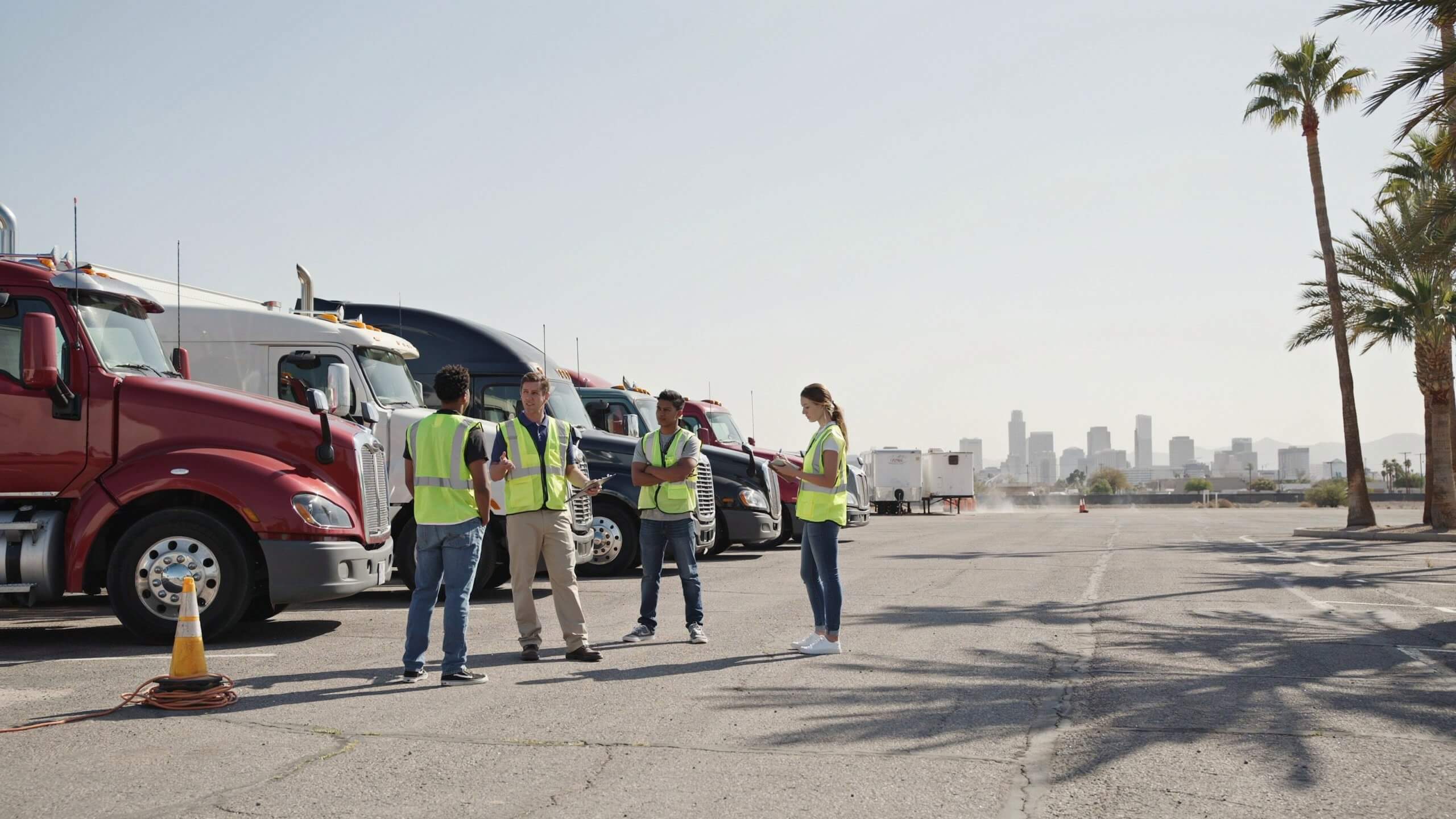
CDL Schools in Phoenix (2026): How to Choose (and Vet) the Right One
A dozen Phoenix schools want your enrollment and telling them apart is the real work. A buyer's guide to the three school types, the red flags that signal a diploma mill, and the 8 questions to ask before you sign.
CDL Schools in Tucson (2026): The Honest Southern Arizona Playbook
Tucson is not a smaller Phoenix. It has its own freight niches, its own funding edge from Davis-Monthan, and one real decision to make: train here or drive up I-10. This is the analyst brief.