
CDL Schools in Phoenix (2026): How to Choose (and Vet) the Right One
A dozen Phoenix schools want your enrollment and telling them apart is the real work. A buyer's guide to the three school types, the red flags that signal a diploma mill, and the 8 questions to ask before you sign.
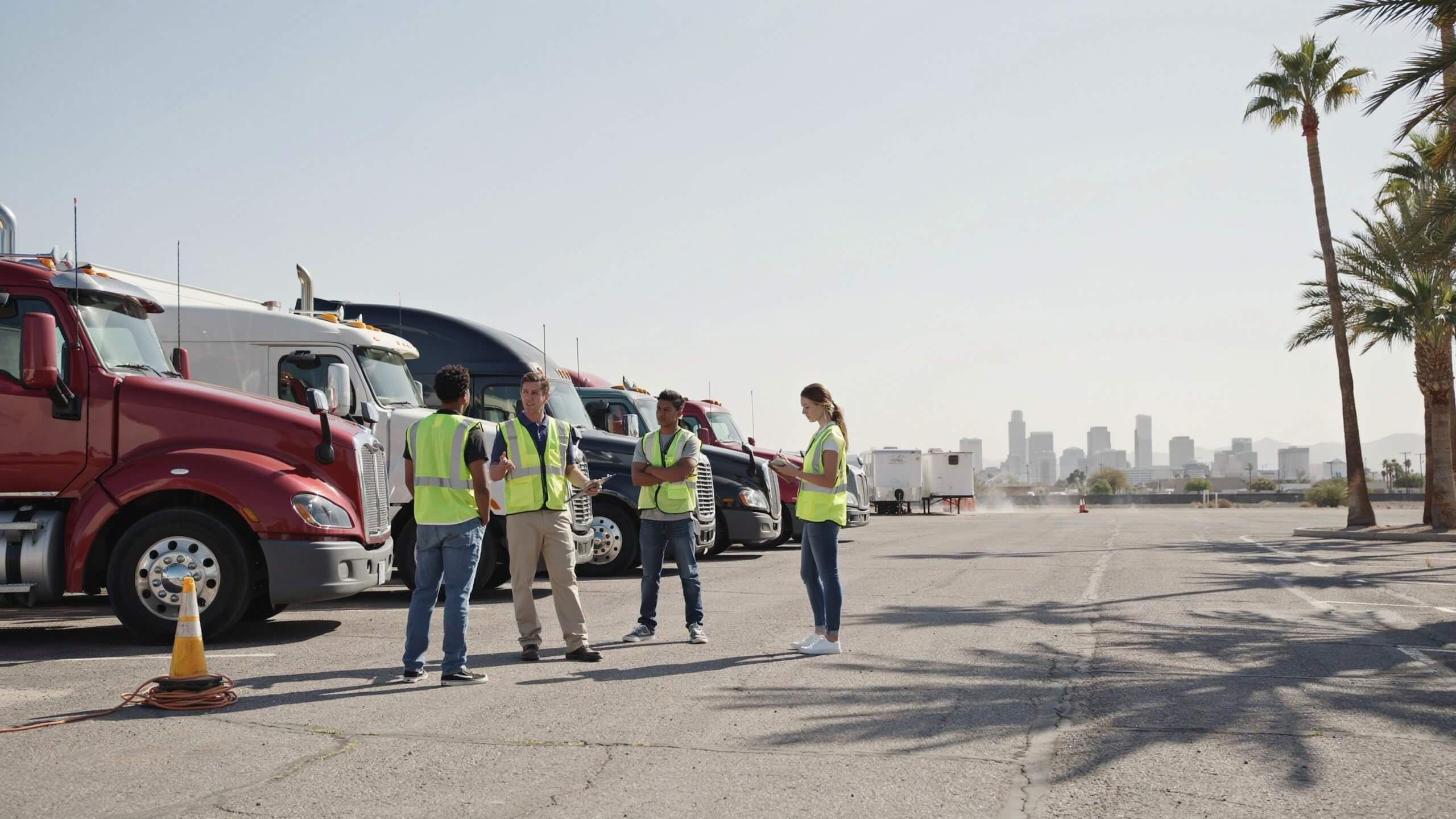
A dozen Phoenix schools are competing for your enrollment, and telling them apart is the real challenge. Here's how not to get burned.
Search "CDL school near me" from a Valley zip code and you will drown. You will see company-sponsored programs, national chains with a Phoenix yard, independent private schools with night-and-weekend schedules, and a handful of community colleges quietly running some of the best training in the state. Every one of them has a five-star average, a "job placement guarantee," and a salesperson who wants your signature today.
That abundance is the problem. When every option looks identical on the surface, the decision stops being about finding a good school and starts being about filtering out the bad ones. This guide is not a ranked list of names, and it is not a set of reviews I invented. It is a buyer's framework: how the three school types actually differ, how to vet any school against the federal rules, and the exact questions that separate a real program from a $5,000 diploma mill. When you want the actual roster of Phoenix schools, that lives on our directory page for CDL schools in Phoenix — this article is how you shop it.
1. Why Phoenix Has So Many Schools
Phoenix did not accumulate this many CDL schools by accident. The metro sits at the crossroads of I-10 (the southern coast-to-coast corridor) and I-17 (the spine north to Flagstaff), which makes the Valley a natural staging ground for freight moving between the California ports and the rest of the country. Two of the largest truckload carriers in North America — Swift and Knight — are headquartered right here. Where the carriers cluster, the training pipelines follow.
Add the fastest-growing warehouse and distribution footprint in the Southwest, a constant construction boom feeding dump and aggregate work, and generous WIOA workforce grants through Maricopa County, and you get a market with more training seats than almost any comparable metro. That is good news for supply and bad news for clarity. More schools means more competition for your enrollment dollars, which means more aggressive marketing — and marketing is exactly the thing you cannot use to judge quality.
Straight Talk: A school's ad budget tells you how badly it needs students, not how well it trains them. The best community-college program in the Valley may not run a single Instagram ad, while a mediocre private school outspends everyone. Ignore the volume of the pitch and judge the substance.
Before you can choose well, you have to know what you are choosing between. Almost every Phoenix option falls into one of three buckets — and they are not competing for the same student.
2. The Three Types of Phoenix School (Compared)
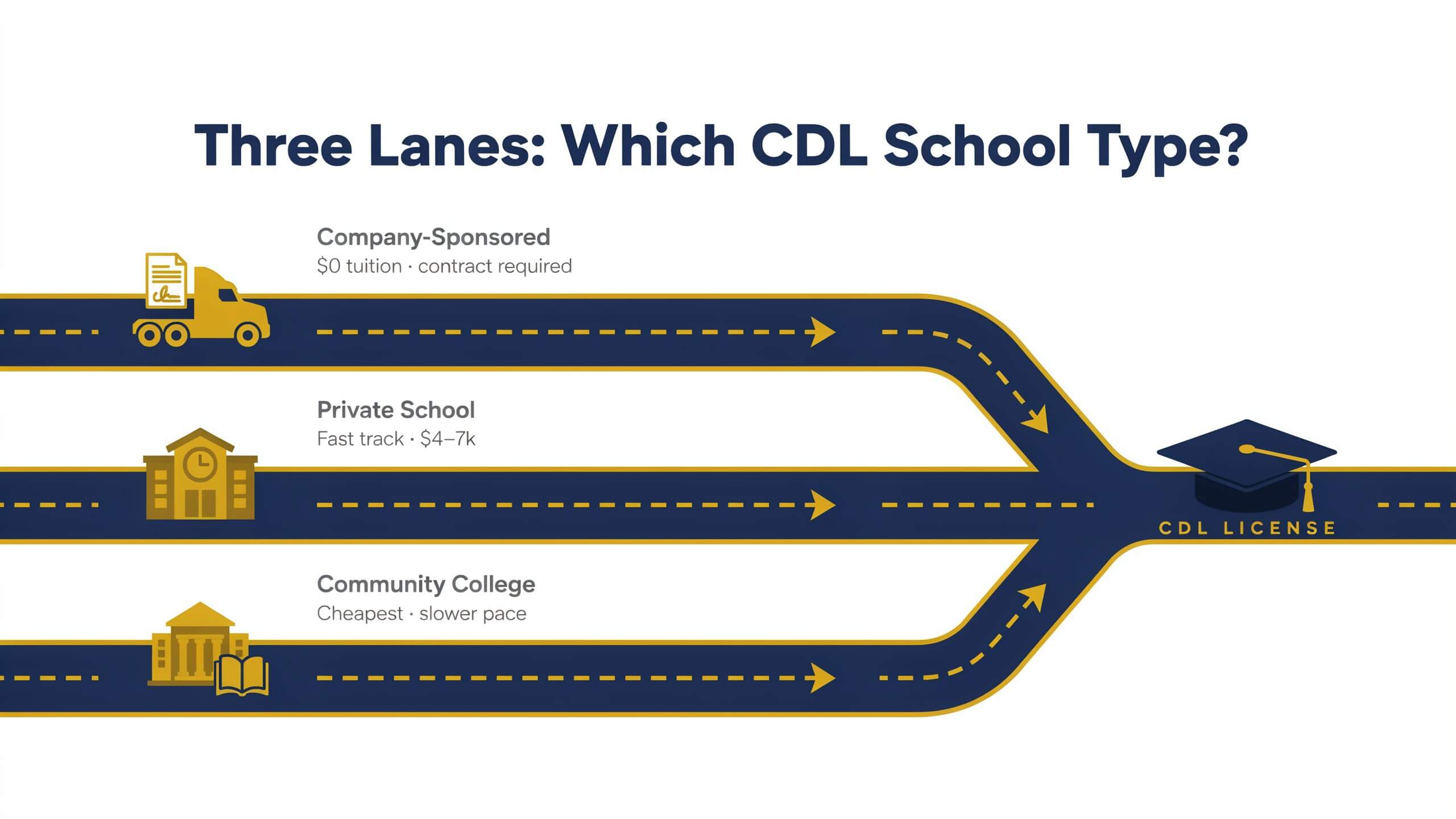
Forget brand names for a minute. Structurally, a Phoenix CDL school is one of three things: a company-sponsored program run by or feeding a carrier, an independent private school, or a community-college program. Each has a distinct price, timeline, and hidden catch. This table is the core of the whole decision — read it slowly.
| Factor | Company-Sponsored (Carrier) | Independent Private School | Community College |
|---|---|---|---|
| Upfront Cost | $0 (tuition fronted by carrier) | ~$4,000–$7,000 | Often lower / subsidized; Title IV aid eligible |
| Typical Length | 3–4 weeks, then over-the-road with a trainer | 3–6 weeks; night/weekend tracks common | 8–15 weeks (semester-paced) |
| Real Advantage | No cash needed; a job is waiting on day one | Fast, flexible, often places graduates with local (non-OTR) employers | High instruction quality, patient pace, cheapest true cost, no employment strings |
| The Catch | A contract. Quit early and you owe the tuition back (often $6,000+). You go where they send you. | You pay real money. Quality varies wildly school to school — vetting matters most here. | Slow. Classes fill months out. Not built for "I need income in three weeks." |
| Job Outcome | OTR / regional for the sponsoring carrier | Flexible — local, regional, or OTR; your choice | Open market; you job-hunt on your own |
| Best-Fit Student | Broke, needs a paycheck immediately, OK with OTR | Career-switcher who wants to stay local and move fast | Budget-focused planner who values quality over speed |
Neutral, real-world examples of each bucket: the sponsored path is what a carrier like Swift or Knight runs; independent private schools include names such as Southwest Truck Driver Training, Phoenix Truck Driving Institute, or Roadmaster; and the community-college lane runs through schools like Pima and other Maricopa-area colleges. I am naming these only so you can recognize the categories in the wild — not ranking them, and not vouching for any single campus. The full Phoenix school directory is where you compare specific locations side by side.
The Cost That Isn't On The Sticker
A "free" sponsored program and a $6,000 private school can end up costing the same. The sponsored deal is a loan you repay in labor at a fixed wage for a year; the private school is cash you can wipe out entirely with a WIOA grant. Compare the total cost — money plus obligation — not the number on the flyer. We break the real math down in the Arizona CDL cost and free-training guide.
3. Which Type Is Right For YOU?
The right school type is not the "best" one — it is the one that matches your money, your timeline, and your appetite for a contract. Run yourself through this matrix before you talk to a single admissions rep. It will kill three-quarters of your options in about ninety seconds, which is exactly what you want.
| Your Situation | Point Yourself Toward | Why |
|---|---|---|
| "I'm broke and need income now." | Company-sponsored | Zero upfront cost and a guaranteed job. You trade a year of commitment for not needing a dime today. |
| "I want a local job, and I want it fast." | Independent private school | Three-to-six-week timelines, night/weekend options, and placement relationships with local Phoenix employers instead of forced OTR. |
| "Cost is my top concern and I can wait." | Community college | Lowest true cost, eligible for Pell and Title IV aid, strong instruction — you just have to accept a semester-length pace. |
| "I qualify for a WIOA grant." | Private OR college (grant-approved) | The grant can cover tuition entirely, which erases the private school's biggest drawback. Confirm the school is on the approved provider list first. |
| "I value freedom and hate contracts." | Anything but sponsored | A sponsored program ties you to one carrier and a repayment clause. Pay your own way and you owe nobody anything. |
If you are still not sure whether trucking as a whole makes sense for your situation, back up one level and read the complete guide to getting your CDL in Arizona before you shop schools at all. And confirm you actually meet the state's baseline — age, medical card, the one-year license rule — in the Arizona CDL requirements and permit guide. There is no point vetting schools if you are not yet eligible to enroll.
4. How To Vet A School
Once you have a type, you still have to separate the legitimate programs from the ones that will take your money and hand you a certificate you cannot use. This is where most students get burned, and it comes down to one non-negotiable federal rule.
The ELDT / TPR Rule Is Not Optional
Since 2022, every entry-level driver must complete training from a school listed on the federal Training Provider Registry (TPR). This is the Entry-Level Driver Training (ELDT) mandate. If a school is not on the registry, your training does not count, the state will not let you take the skills test, and you have paid for nothing. This is the very first thing to verify — before price, before schedule, before anything.
- Ask the school for its exact legal name and confirm it appears on the FMCSA Training Provider Registry. Do not take their word for it — look it up yourself.
- Cross-check licensing and testing details against the official ADOT CDL page. Arizona's ELDT provider must feed a valid skills test through MVD or an Authorized Third Party.
- A school that hesitates, gets defensive, or "will email you the registry link later" is telling you something. A legitimate provider knows its TPR status cold.
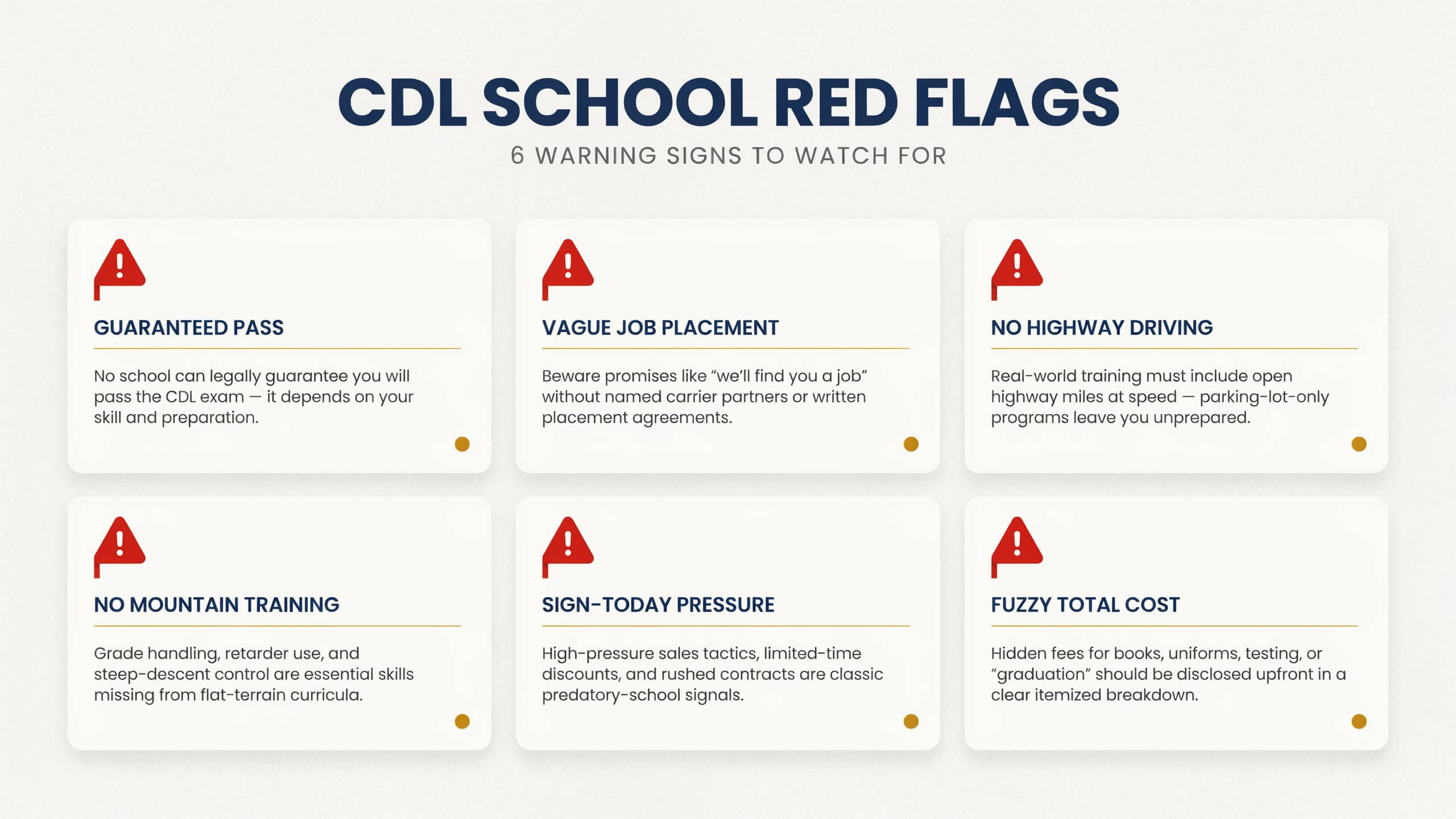
The Red Flags That Should End The Conversation
Beyond the registry check, a handful of sales tactics reliably mark a school you should walk away from. None of these is subtle once you know to look for them.
- "Guaranteed pass" or "guaranteed license." No honest school can guarantee you pass a state skills test. This promise is a marketing lie, and a school that lies to enroll you will lie about your training too.
- Vague or unverifiable "job placement." "We have great placement" means nothing. Real numbers, named employer relationships, and a willingness to connect you with recent graduates mean something. If the placement stat has no source, treat it as fiction.
- No highway or interstate driving. If the program only runs city streets and a practice pad, you are not ready for I-10 traffic or the I-17 grades north of town — and your first employer will find out the hard way.
- No mountain or grade training at all. Phoenix drivers end up on real descents. A school that never puts you on a grade is training you for a test, not a job.
- Pressure to sign today. "This price is only good if you enroll right now" is a closing tactic, not a real deadline. Good schools are fine with you sleeping on it.
- Fuzzy total cost. If they cannot give you an all-in number in writing — tuition, fuel, testing, re-test fees, endorsements — assume the final bill will be higher than the quote.
Don't Get Burned Here
The biggest scam pattern is a school that is not on the Training Provider Registry but takes your enrollment anyway. You train for weeks, feel good, show up for your skills test — and the examiner turns you away because your provider was never certified. There is no refund and no recourse that gets your time back. Verify the registry entry before you pay a deposit, every single time. For the full anatomy of school scams and how to dismantle a sales pitch, read how to choose a CDL school and avoid the scams.
5. The 8 Questions To Ask Before You Sign
You have narrowed to a type and screened for red flags. Now you make one call to each finalist and ask these eight questions in order. Write the answers down. A school that stumbles on three or more of them is not your school — no matter how good the yard looks on the tour.
- "What is your exact legal name on the Training Provider Registry?" Then go verify it yourself on the FMCSA site. This is the pass/fail question — everything else is secondary.
- "Are you a Third Party Tester, or do I test at the MVD?" In-house or Authorized Third Party testing means you test where you trained, in a truck you know. Being sent to a strange MVD lot is a real disadvantage.
- "What is the all-in cost in writing — including fuel, testing, and re-tests?" Get a single number. Compare that number, not the advertised tuition, across schools.
- "Do we drive on real highways and any mountain grades, or only city streets and the pad?" Phoenix jobs demand both. "Just the pad" is disqualifying.
- "What is the student-to-truck ratio, and how many hours behind the wheel do I actually get?" Six students sharing one truck is very different from two. Seat time is the whole point.
- "Can I speak with two graduates from the last three months?" A confident school hands you names. A nervous one changes the subject.
- "Do you accept WIOA, GI Bill, or Pell, and are you on the approved provider list for them?" If you qualify for funding, this determines whether the school is even reachable for you. Being TPR-listed does not automatically mean grant-approved.
- "What exactly happens if I fail the skills test — do I re-train and re-test for free, or does it cost more?" The answer reveals whether they are invested in your outcome or just your deposit.
CAUTION: Ask before you pay, not after.
Every one of these questions is easy to answer honestly and easy to dodge dishonestly. Ask them on the phone or on the tour, before any deposit changes hands. Once your money is in, your leverage is gone.
6. Cost And Free Options In Phoenix
Sticker prices in Phoenix run roughly $4,000 to $7,000 for a private Class A program, materially less at community colleges, and effectively $0 upfront for company-sponsored routes (with the repayment obligation baked in). But the number you actually pay can be far lower, because the Valley has more funding paths than almost anywhere.
- WIOA grants through ARIZONA@WORK (Maricopa County) can cover tuition in full for eligible laid-off, low-income, or SNAP-receiving students — leaving you debt-free and contract-free.
- GI Bill benefits apply at approved schools if you are a veteran.
- Pell / Title IV aid is available at community colleges, which is part of why the college lane is the cheapest true cost.
Do not assume you have to pay retail. A meaningful share of Phoenix students train for little or nothing once the grants clear. The full breakdown — every fee, every funding source, and which "free CDL training in Phoenix, AZ" offers are real versus which are contracts in disguise — is in the Arizona CDL cost and free training guide. Work out your funding before you choose a school, because it can flip which type is even affordable for you.
Worth Knowing: If you are shopping the wider region, Tucson runs a smaller but similarly structured market — the same three school types, the same vetting rules. Our CDL schools in Tucson guide applies this same framework two hours south.
You now have the whole toolkit: the three types and their catches, a decision matrix that eliminates the wrong lanes, the red flags that end a conversation, and the eight questions that expose a weak program. What you do not have — and cannot get from a blog post — is the current, side-by-side list of specific Phoenix schools with locations, programs, and contact details. That is the one thing the directory does that this article deliberately does not. Take this framework, open our directory of CDL schools in Phoenix, and run your top two or three finalists through the eight questions today. The schools are all competing for you — make them earn it, verify the registry entry yourself, and enroll only in the one that answers cleanly. Start your shortlist on the Phoenix schools page now.
Ready to Find CDL Schools?
Search for CDL training programs in your area. Start your journey to becoming a professional truck driver today.
Find CDL Schools Near YouRelated Articles
How to Get a CDL in Arizona (2026): The Ultimate Phoenix & Tucson Guide
Arizona is the logistics gateway to the West. The complete 2026 battle plan to skip the MVD line with the ATP hack, unlock Maricopa WIOA funding, transfer a California license, choose the right Phoenix or Tucson school, and survive the I-17 mountain grades.
Arizona CDL Cost & Free Training (2026): The Real Price Breakdown + WIOA/GI Bill
The sticker price on a Class A CDL is not the number that empties your bank account. Here is the true all-in cost of getting licensed in Arizona in 2026, line by line, plus every path to getting it paid for through WIOA, the GI Bill, and Pell.
Arizona CDL Requirements, Permit & Manual (2026): The Complete MVD Checklist
Before you spend a dollar on a truck school, run this qualification checklist. The exact age, licensing, residency, medical, and ELDT boxes Arizona’s MVD and the FMCSA make you tick before you can hold a Commercial Learner’s Permit.