
Arizona CDL Practice Test (2026): Real Sample Questions, Answers & the 80% Math
Stop reading study guides and start answering questions. Ten representative Arizona CDL sample questions with answers explained, plus the 80%-per-module math and a skip strategy that tells you exactly which tests to take.

Before you read another word, try this one:
Q. You are driving a 40,000-lb combination on I-17 near Sunset Point and you feel the trailer start to swing out behind you in a curve. What is happening, and what do you do first?
- A. The tractor is skidding; steer hard the other way.
- B. The trailer is in a rearward amplification "crack-the-whip" swing; stop braking and ease off the accelerator.
- C. The trailer brakes have failed; pull the trailer hand valve all the way down.
- D. Nothing is wrong; trailers always do that on grades.
Answer: B. That swing is rearward amplification — the "crack-the-whip" effect that throws the rear trailer far harder than the cab feels. Grabbing the trailer hand valve (answer C) is the classic trap; using the hand valve during a skid makes the swing worse. The manual answer is to release the brakes, let the wheels roll, and get off the accelerator so the trailer can straighten out. If you picked C, you are exactly the reader this article is for.
Miss that one? Good — better here than at the MVD. Everything below is built the same way: a question, the options, then the answer and why. These are representative sample questions written to mirror the style and difficulty of the Arizona knowledge tests. They are not copies of the official exam, and the only source that counts on test day is the current official ADOT CDL manual. Treat this as drilling reps, not memorizing an answer key.
1. What the MVD Actually Tests
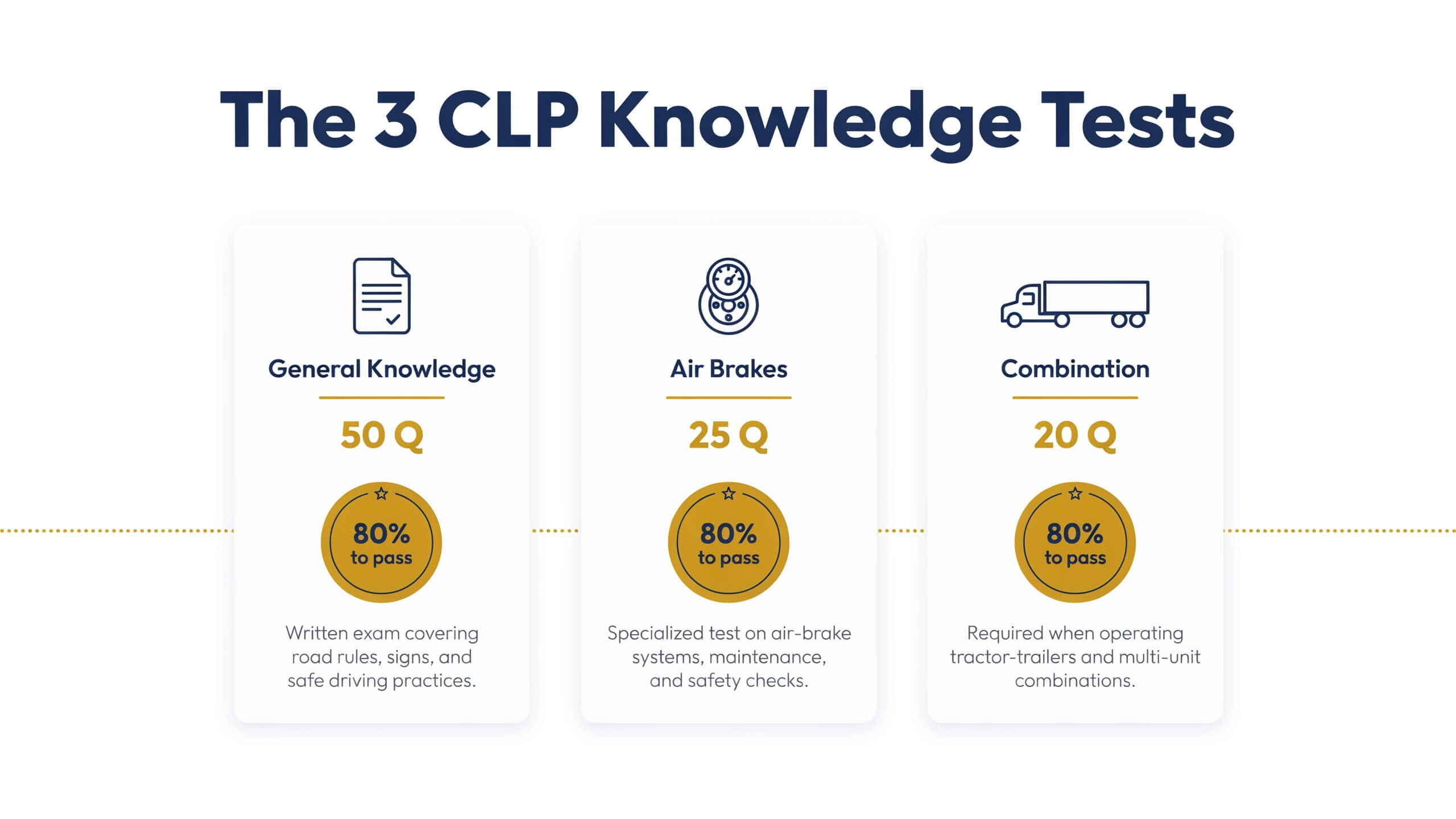
Arizona's written CDL knowledge exams are administered through the MVD (Motor Vehicle Division) under ADOT — or, more comfortably, through an Authorized Third Party (ATP) office that runs the same state tests without the government line. For a full Class A CLP you face three separate tests, and here is the part that trips people up: each one is scored on its own, and each one needs 80% to pass. There is no combined average.
| Module | Approx. Questions | Passing Score (80%) | Max Misses Allowed |
|---|---|---|---|
| General Knowledge | 50 | 40 correct | 10 |
| Air Brakes | 25 | 20 correct | 5 |
| Combination Vehicles | 20 | 16 correct | 4 |
Question counts vary slightly by testing system, but the 80% cut line does not move. General Knowledge is mandatory for everyone. Air Brakes and Combination Vehicles matter depending on what you actually want to drive — more on that in the skip strategy in section 6. First, let's find out how much you really know. New to the whole process? Start with how to get a CDL in Arizona and the breakdown of Arizona CDL requirements and the permit manual.
2. General Knowledge: Four Sample Questions
This is the 50-question monster everyone has to pass. It ranges from stopping distances to cargo securement to what to do when things break. Answer honestly before you open the box.
Q1. You are stopped behind another vehicle on a level road. Roughly how much space should you leave so you can pull out around it if it stalls?
- A. Enough to see the top of its rear tires touching the pavement.
- B. One truck length.
- C. As close as possible so nobody cuts in.
- D. Exactly 15 feet, measured.
Answer: A. The manual's rule of thumb is that when you can see the rear tires touching the road at the point where they meet the pavement, you have enough room to steer around without backing up. It sounds oddly specific because it is — the test loves this one. "One truck length" feels right but is not the taught answer.
Q2. Your total stopping distance is made up of three parts. Which set is correct?
- A. Perception distance + reaction distance + braking distance.
- B. Reaction distance + braking distance + weight distance.
- C. Following distance + braking distance + weather distance.
- D. Perception distance + braking distance only.
Answer: A. Perception + reaction + braking. Perception is the time from seeing the hazard to your brain registering it; reaction is moving your foot to the pedal; braking is the truck actually slowing. At 55 mph on dry pavement, a loaded rig needs roughly the length of a football field including end zones to stop. Underestimating this is why tailgating a big truck is a bad idea for everyone.
Q3. When should you use your emergency (parking) brakes?
- A. Every time you slow for a red light.
- B. Only in a true emergency or when parking.
- C. To hold the truck on the I-17 grade instead of the service brakes.
- D. Whenever the trailer feels heavy.
Answer: B. Parking brakes are for parking or genuine emergencies — not routine slowing. Riding them or using them to hold a load on a grade is exactly the misuse the question is fishing for. On a long Arizona descent you control speed with a low gear and the engine/service brakes in a snub pattern, not by dragging the spring brakes.
Q4. You are hauling a load of loose gravel out of a Phoenix aggregate pit. How should the cargo be secured and inspected?
- A. Check it once before leaving; the pit loaded it, so it's their problem.
- B. Inspect within the first 50 miles, then re-check at each break or every 150 miles / 3 hours.
- C. Only re-check if you hear it shifting.
- D. Cargo securement rules don't apply to dump loads.
Answer: B. You must re-inspect cargo within the first 50 miles, then again every 150 miles or every 3 hours (or whenever you change duty status), whichever comes first. And "the pit loaded it" is never a defense — the driver is legally responsible for the load, period. In Arizona's belly-dump and end-dump world this comes up on the job as often as on the test.
Worth Knowing: General Knowledge questions are drawn from a large pool, so no two people see the identical 50. That is exactly why memorizing a leaked "answer key" backfires — you have to understand the concept, because the numbers and phrasing shift. Every explanation above points back to a manual section for a reason.
3. Air Brakes: Three Sample Questions (and the "L" Trap)
The Air Brakes test is only about 25 questions, but it carries a sting that General Knowledge does not — and it has nothing to do with the score. Answer these first, then read the box.
Q5. With the engine off and the parking brake released, you do a static air-loss test. What is the maximum allowable air pressure loss for a combination vehicle?
- A. 2 psi in one minute.
- B. 3 psi in one minute.
- C. 4 psi in one minute.
- D. Any loss is a failure.
Answer: B. With the engine off and the brakes released (a static test), the allowable leakage is 3 psi per minute for a combination vehicle and 2 psi for a single vehicle. The trap is mixing this up with the brakes-applied test, where the limits rise to 4 psi (combination) and 3 psi (single). Four numbers, two tests — learn which pair goes with "released" vs "applied." These figures also show up word-for-word in the air-brake portion of your road-test pre-trip inspection checklist.
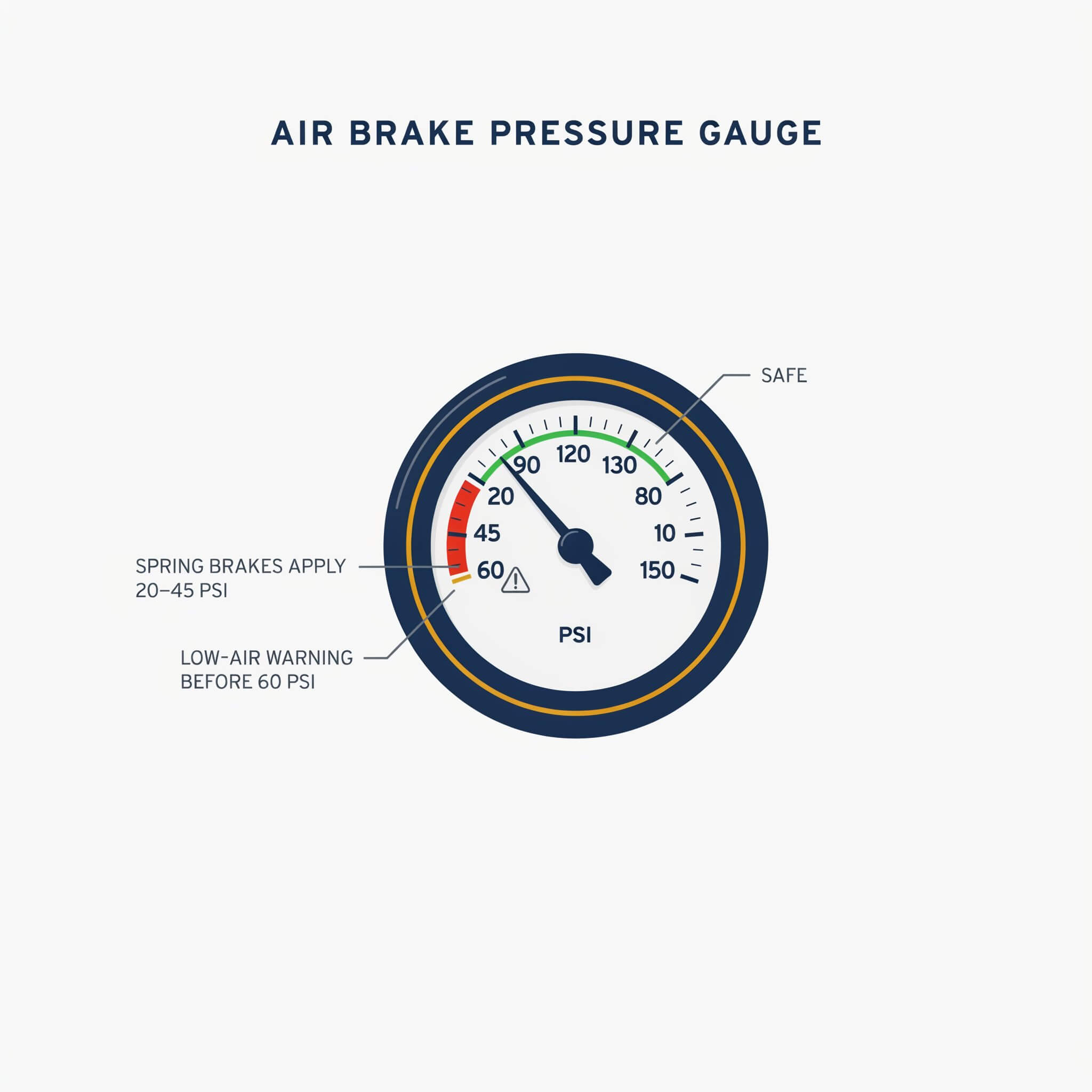
Q6. At what pressure does the low-air-pressure warning (light and buzzer) have to come on?
- A. Below 20 psi.
- B. Below 60 psi (or per manufacturer, but typically 55–75 psi).
- C. Below 100 psi.
- D. Only when the brakes have already locked.
Answer: B. The low-air warning must activate before pressure drops below about 60 psi (commonly in the 55–75 psi band). Keep dropping and, somewhere around 20–45 psi, the spring brakes apply automatically and the truck stops itself. The whole system is designed to fail safe — but the exam wants you to know the warning fires long before that.
Q7. Why should you drain the air tanks (or confirm the automatic drains work)?
- A. To make the compressor run less.
- B. To remove water and compressor oil that can foul the system.
- C. To increase maximum air pressure.
- D. You never drain the tanks.
Answer: B. Compressed air carries water and a little oil that collect in the tanks. In cold weather that water can freeze and knock out your brakes; year-round it corrodes and gums up valves. Draining (or a working automatic drain) keeps the air clean.
The "L" That Costs You a Job
Here is the trap nobody warns you about: if you take your skills test in a vehicle without air brakes, or you skip the Air Brakes knowledge test, the state stamps an "L" restriction on your license — and an "L" means "no air-brake-equipped commercial vehicles." Nearly every real Class A tractor on the road runs air brakes. So the "L" quietly disqualifies you from the exact jobs you got the CDL for. To keep it off your license you must (1) pass the Air Brakes written test, and (2) take your road test in a truck that actually has a working air-brake system. Don't test in grandpa's hydraulic-brake straight truck and wonder why Swift won't hire you.
4. Combination Vehicles: Three Sample Questions
This 20-question test is all about the tractor-trailer relationship: coupling, the fifth wheel, and the physics of pulling something long behind you. You already met rearward amplification in the opening question — that concept lives here.
Q8. After coupling, how do you confirm the fifth wheel jaws have locked onto the kingpin?
- A. Look at the trailer from the side; if it's level, you're good.
- B. Do a "tug test" in low gear against the locked trailer brakes, then visually confirm no gap and the locking jaws around the kingpin.
- C. Honk the horn and listen for a click.
- D. Trust the sound of the pin dropping in.
Answer: B. Two checks, both required: a tug test (gently pull forward against the locked trailer brakes to prove the connection holds) and a visual inspection — get under and confirm there is no gap between the upper and lower fifth wheel and that the jaws are closed around the kingpin. A high hook or a gap means the pin is riding on top of the jaws and the trailer can drop. Sound alone (C, D) proves nothing.
Q9. Where should the fifth wheel be positioned relative to the trailer kingpin before backing under it?
- A. So the kingpin is well ahead of the fifth wheel.
- B. So the trailer is a little low and the fifth wheel will lift the trailer slightly as you back under.
- C. So the trailer is much higher than the fifth wheel.
- D. Position doesn't matter as long as you back in fast.
Answer: B. Set the trailer low enough that the fifth wheel raises it slightly as you back under. Too high and you'll hit the nose or ride up over the kingpin; way too low and you'll jam the apron. And you back under slowly — never fast. This is textbook coupling sequence and a frequent test item.
Q10. An empty combination vehicle actually takes ______ to stop than a fully loaded one, and its wheels can lock up more easily.
- A. Less distance
- B. More distance
- C. The same distance
- D. It cannot stop at all
Answer: B. Counterintuitive, and that's the point. Empty trucks often need a longer stopping distance than loaded ones, because the brakes and tires are engineered for a heavy load — with no weight pushing the tires down, they get less traction and lock up more easily. New drivers assume "lighter = stops faster." The manual (and the road) say otherwise.
5. The 80% Rule: How Each Module Is Actually Scored
This is the mechanic that quietly fails prepared people. The 80% is applied per module, not across your whole day. You can ace two tests and still walk out without a permit because you missed the third by one question.
Run the Math Before You Book
Passing is 0.80 × (number of questions), rounded to whole questions, on each test:
- General Knowledge: 0.80 × 50 = 40 correct. Miss 11 and you fail — even if you nailed Air Brakes 25/25.
- Air Brakes: 0.80 × 25 = 20 correct. Only 5 misses allowed. This is the tightest margin of the three.
- Combination: 0.80 × 20 = 16 correct. 4 misses and you're done.
There is no averaging. A 100 / 100 / 75 across the three modules is still a fail on module three — you re-take only that one, but you don't get the permit until every module clears 80%.
The practical takeaway: your weakest module decides your day, so aim your studying at the test you're least confident on, not the one you already enjoy. Air Brakes, with its razor-thin 5-miss allowance and pile of specific psi numbers, is where most people should spend their extra hour. For the mindset and pacing that gets you through all three in one sitting, read how to pass the CDL permit test (CLP).
6. The Skip Strategy: Which Modules You Actually Need
Not everyone needs all three tests. The MVD only makes you pass the modules that match the vehicle and endorsements you're after — so taking a test you don't need just adds a chance to fail. Match your goal to the row below.
| Your Goal | Gen. Knowledge | Air Brakes | Combination |
|---|---|---|---|
| Class A (tractor-trailer, OTR/local) | Required | Take it (avoid the "L") | Required |
| Class B, air brakes (bus, dump, box) | Required | Take it (avoid the "L") | Skip |
| Class B, hydraulic brakes only | Required | Skip (accept "L") | Skip |
| Just the CLP to start school | Required | Strongly advised | Strongly advised |
CAUTION: "Skip" is not "free."
Skipping Air Brakes is only smart if you genuinely never plan to drive an air-brake vehicle — which rules out almost every Class A job in Arizona. When in doubt, take all three now. Re-testing later means another trip and another fee.
7. A 7-Day Drill Plan
You don't need a month. You need a week of focused reps against the manual. Here's a lean schedule that respects the 80%-per-module reality.
- Day 1 – Read General Knowledge: Cover to cover, highlighting numbers (stopping distances, following-distance rules, space management).
- Day 2 – Drill General Knowledge: Answer sample questions, and for every miss, go find the manual paragraph. Understanding beats memorizing.
- Day 3 – Air Brakes: Read it twice. Write the key psi numbers (60 psi warning, ~20–45 psi spring apply, 3/4 psi leak limits) on a card.
- Day 4 – Combination Vehicles: Focus on coupling sequence, fifth-wheel checks, and rearward amplification.
- Day 5 – Mixed review: Take all three sets of questions in one sitting to simulate a real MVD/ATP visit.
- Day 6 – Attack your weakest module only: Whichever test scored lowest yesterday gets your whole day.
- Day 7 – Light review + rest: Skim your number card, sleep, and book the test. Cramming the morning of hurts more than it helps.
Straight Talk: The single biggest score-killer is treating practice questions as trivia. Every time you miss one, the fix isn't to note the letter — it's to read why in the manual. Do that for a week and 80% stops being a threat.
8. How Ready Are You?
Run through all ten sample questions above (plus the opener) as a clean set, then find your honest percentage on this grid. It interprets your practice score — the official test is still its own animal.
| Your Practice Score | What It Means | Your Move |
|---|---|---|
| Under 70% | You're guessing on concepts, not just wording. | Go back and re-read the manual module by module before any more quizzing. |
| 70–85% | You know the material but have soft spots. | Drill your weak module specifically — usually Air Brakes numbers or coupling steps. |
| Over 85% | You're clearing the 80% line with margin on every module. | Book the test. Waiting longer just lets details fade. |
When you're consistently over 85% on all three, stop studying and go pass it. Bring your documents, take the tests at an ATP office to skip the government line, and remember the CLP's 14-day hold before your skills test starts the clock the moment you pass. When you're ready to line up training and testing, browse CDL schools in Phoenix — and keep the official ADOT CDL manual open as your source of truth. These sample questions got you sharp; the manual gets you licensed.
Ready to Find CDL Schools?
Search for CDL training programs in your area. Start your journey to becoming a professional truck driver today.
Find CDL Schools Near YouRelated Articles
Arizona CDL Requirements, Permit & Manual (2026): The Complete MVD Checklist
Before you spend a dollar on a truck school, run this qualification checklist. The exact age, licensing, residency, medical, and ELDT boxes Arizona’s MVD and the FMCSA make you tick before you can hold a Commercial Learner’s Permit.
How to Get a CDL in Arizona (2026): The Ultimate Phoenix & Tucson Guide
Arizona is the logistics gateway to the West. The complete 2026 battle plan to skip the MVD line with the ATP hack, unlock Maricopa WIOA funding, transfer a California license, choose the right Phoenix or Tucson school, and survive the I-17 mountain grades.

The Ultimate Guide to Passing the CDL Permit Test (CLP) in 2026
Dreading the written exam? Stop reading the 180-page DMV manual. Here is the massive, step-by-step strategy to crush General Knowledge, Air Brakes, and Combination Vehicles on your first try.