
Night & Weekend CDL Training: The "Keep Your Job" Guide to Switching Careers (2026)
Can't afford to quit your job for 4 weeks? Part-time CDL classes are the solution. We break down the cost, the 16-week timeline, and the brutal reality of the "Zombie Schedule."

The biggest barrier to becoming a truck driver isn't the tuition cost; it's the "Opportunity Cost."
Most CDL schools operate like a military boot camp: Monday to Friday, 7:00 AM to 4:00 PM, for 4 weeks straight. This creates a massive problem for the average American working class family. If you have a mortgage, a car payment, or kids to feed, you likely cannot afford to go a whole month without a paycheck.
This is where Part-Time Training (Night & Weekend Classes) comes in. It is the "Golden Bridge" that allows you to switch careers without putting your family's financial security at risk.
But recruiters often sugarcoat the reality. They call it "flexible." We call it "The Zombie Schedule." Before you sign up for 4 months of grinding work, here is the unfiltered truth about getting your CDL part-time.
1. The Math: Why "Fast" Training is Actually More Expensive
When you look at the price tag of a CDL school, you usually just see the tuition ($4,000 - $6,000). But you are forgetting the most expensive part of the equation: Lost Wages.
Let's compare two scenarios for a student currently earning $3,500/month at a warehouse or construction job.
| Expense Factor | Scenario A: Full-Time School (Quit Job) | Scenario B: Night/Weekend School (Keep Job) |
|---|---|---|
| Tuition Cost | $5,000 | $5,000 |
| Lost Wages | $3,500 (1 Month Unemployed) | $0 (Still Earning) |
| Living Expenses | $2,000 (Must pay from savings) | $0 (Covered by paycheck) |
| TRUE COST | $10,500 | $5,000 |
The Verdict: Going to school full-time is actually double the cost when you factor in your lost income. If you don't have $5,000 in cash savings on top of your tuition money, part-time isn't just an option; it's a necessity.
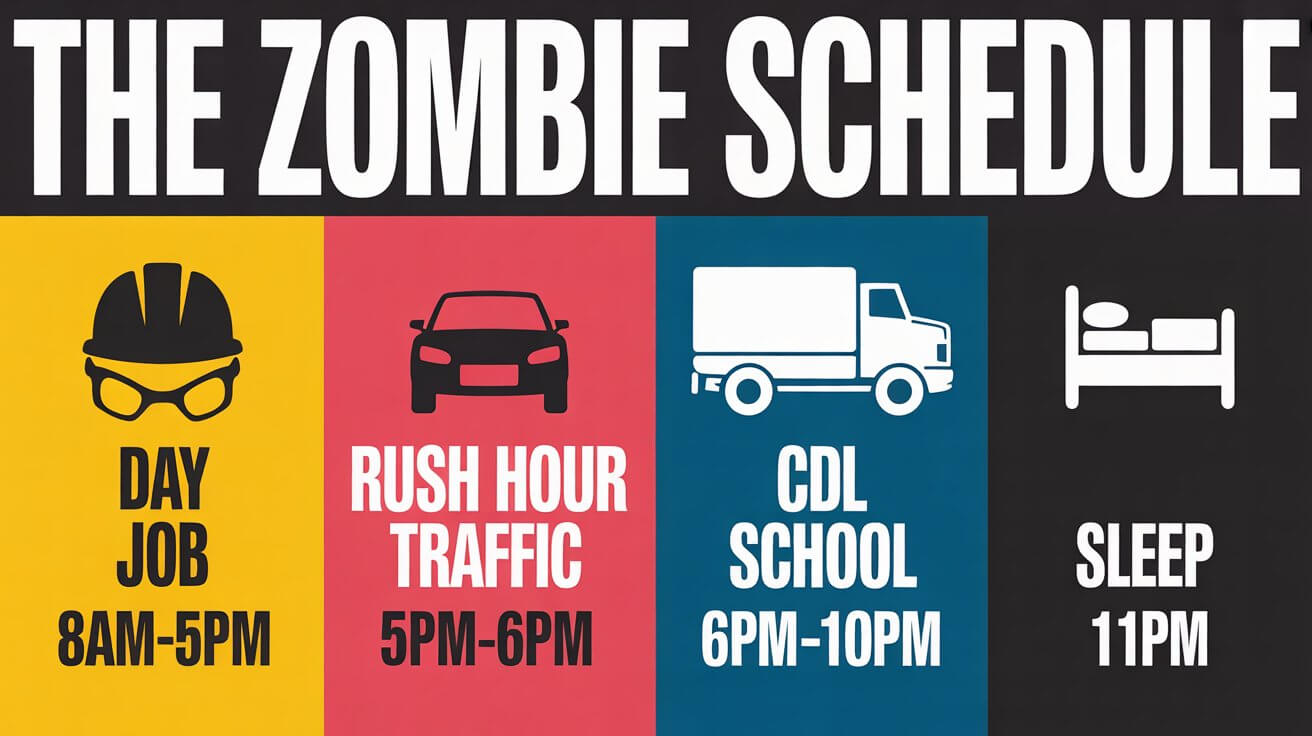
2. The "Zombie Schedule": A Day in the Life
I have seen many students quit night school not because the backing maneuvers were hard, but because the exhaustion broke them. You are essentially working two full-time jobs.
Here is what a typical Tuesday looks like for a Night Student:
- 6:00 AM: Wake up, get kids ready for school.
- 8:00 AM - 5:00 PM: Work your primary job (Construction, Warehouse, Retail). It's physically draining.
- 5:00 PM - 6:00 PM: Rush hour traffic to get to the CDL school. You eat a cold sandwich or fast food in the car.
- 6:00 PM - 10:00 PM: The "Second Shift." Pre-trip inspection, backing practice, night driving on the highway.
- 10:30 PM: Drive home.
- 11:15 PM: Shower and collapse.
- Repeat for 12 weeks.
If you choose Weekend Classes (usually Sat/Sun 8 AM - 4 PM), you are working 7 days a week. According to the Bureau of Labor Statistics (BLS), heavy truck driving is already a high-fatigue profession; starting your career exhausted increases the risk of burnout before you even get your license.
3. The 160-Hour Reality: Why It Takes 4 Months
Recruiters will vaguely say "it takes a few months." Let's look at the hard math required by the new FMCSA ELDT regulations and insurance standards.
To be hireable by a major carrier, you generally need a certificate verifying 160 Clock Hours of training.
- Full Time: 40 hours/week = 4 Weeks. (Fast)
- Night Class: 20 hours/week = 8 Weeks. (Medium)
- Weekend Class: 16 hours/week = 10 Weeks. (Slow)
The "Real World" Delay: The math above assumes perfect attendance and no holidays. In reality, you will get sick, the truck will break down, or the school will close for Thanksgiving. Realistically, a weekend program takes 12 to 16 weeks.
4. The Hidden Advantage: The "Empty Yard" Secret
Here is a secret the schools won't advertise: Night classes are usually the best place to actually learn how to drive.
The Day Class Problem: CDL schools run on volume. In a day class, you might be one of 20 or 30 students. You fight for time on 3 trucks. You might spend 4 hours a day just standing on the asphalt watching other people back up.
The Night Class Advantage:
- Low Ratio: Night classes often have only 4 to 6 students.
- Max Seat Time: You are in the driver's seat 3x more often.
- Night Experience: You learn to drive in the dark, dealing with headlight glare and low visibility. Since trucking is a 24/7 industry, you will be much better prepared than the "Day Shift" students.
Insider Tip
When touring a school, ask: "What is the student-to-truck ratio for the night class specifically?" If they say 3-to-1 or better, sign up immediately.
5. Who Actually Offers Part-Time? (It's Not Swift)
This is the most frustrating part for students. You call a recruiter at a Mega Carrier (like Swift, Prime, or Werner) for their Sponsored Training program, and ask for night classes.
The Answer: NO.
Mega Carrier schools are factories. They operate on a strict, fast-paced schedule to churn out drivers. They do not have the patience for a 4-month part-time student. They provide hotel and food, so they expect you to be there 24/7.
Where to find Night/Weekend Classes:
- Community Colleges: These are the gold standard for part-time. They cater to working adults. Look for programs in Phoenix (Maricopa), Houston (HCC), or Jacksonville (FSCJ).
- Independent Private Schools: Smaller, local schools ("Mom and Pop" schools) are more flexible. They need your tuition money, so they adapt to your schedule.
Use our School Locator and filter for "Private Schools" to find these local gems.
6. How to Survive the Grind (Burnout Prevention)
Statistically, the dropout rate for weekend classes is higher than full-time classes. Why? Because 4 months is a long time to sustain high stress. Life gets in the way.
To survive, you need a strategy:
The "Family Contract"
Sit down with your spouse and kids before you start. Explain: "For the next 12 weeks, I will be a ghost. I will be tired and grumpy. But I am doing this so we can have a better life this year." You need their buy-in, or the domestic stress will make you quit.
The Logistics
- Meal Prep: You cannot survive on gas station hot dogs for dinner every night. Cook 5 meals on Sunday.
- Caffeine Discipline: Stop drinking coffee at 8 PM, or you won't sleep when you get home at 11 PM.
- Study Audio: Use your commute to listen to CDL prep audiobooks instead of music. Turn your car into a classroom.
7. Will I Get Hired if I Graduate Slowly?
Many students fear that taking 4 months to graduate looks "bad" to recruiters.
The Truth: Recruiters do not care how long it took you to get your license. A quick search on Indeed for Recent Grad jobs shows thousands of openings that simply require a valid CDL-A.
They care about two things:
- Do you have a valid CDL-A?
- Can you pass the drug test? (See our Deal Breakers Guide).
In fact, graduating from a 16-week Community College program often looks better than a 3-week crash course, because it shows you have more training hours and the discipline to hold down a job while studying.
The Bottom Line
Night and weekend training is not for the weak. It is a grueling marathon that tests your mental and physical limits. But for the working parent, it is the smartest financial move you can make.
By keeping your job, you graduate with your bills paid, your savings intact, and the freedom to choose any employer you want—without being shackled by a contract.
Ready to find a schedule that works? Check your local CDL schools and ask specifically for their "Part-Time Packet."
Ready to Find CDL Schools?
Search for CDL training programs in your area. Start your journey to becoming a professional truck driver today.
Find CDL Schools Near YouRelated Articles

5 Hidden Deal-Breakers That Kill Your Trucking Career Before It Starts
You have your CDL, but can you get hired? From hair follicle drug tests to the "Sleep Apnea Racket," the "Under-21" insurance wall, and the dreaded "E" Restriction, here is what actually disqualifies drivers in 2026.